CERTIFICATE III IN CARPENTRY
Study Carpentry Course
If you are looking for a flexible job and want to build skills that allow you to work all over the world, perhaps you may want to study carpentry.
On this page

This site is protected by reCAPTCHA and the Google Privacy Policy and Terms of Service apply.
Certificate III in Carpentry
Medium and Long-term Strategic Skills List (MLTSSL). This means immigration has identified carpenters as an in-demand occupation in Australia.
Australia is recognised for providing highly skilled and technologically sound carpenters. The Certificate III in Carpentry will provide students with the required skills to work in the building and construction industry in Australia and all over the globe. If you study carpentry you will learn to perform a wide range of tasks in the building and construction industry.
You will be trained in numerous fields in the carpentry industry such as studying drawings and specifications to determine materials required, ordering and selecting timbers and materials, preparing layouts and much more.
Graduates will be a qualified tradesperson in the building and construction industry, skilled in many aspects of carpentry including:
- Plan and organise work
- Construct wall frames
- Use carpentry hand and power tools
- Read and interpret plans
- Shape materials and assemble component
- Roof framing
- Use a variety of levelling instruments
- Applicant must be 18 years of age or older.
- Completion of Year 10 (or equivalent)
- Be prepared to complete a 360 hour of vocational placement or work experience
- English language evidence
-
- IELTS, PTE, etc. (IELTS: 6.0 overall – no band less than 5.5; OR equivalent). The test result must be valid within 2 years at the time of the visa application.
- Some Education Institutions offer an in-house English Placement Test that you can take to meet the English entry requirements.
- Exemptions apply if:
– you are a citizen and hold a passport from UK, USA, Canada, NZ or Republic of Ireland
– you are enrolled in a principal course of study that is a registered school course, a standalone English Language Intensive Course for Overseas Students (ELICOS), a course registered to be delivered in a language other than English, or a registered post-graduate research course
– you have completed at least 5 years of study in English in one or more of the following countries: Australia, UK, USA, Canada, New Zealand, South Africa, or the Republic of Ireland.
-
- Full-time carpenters on average earn $1,358 per week
- The average hours worked in Australia are 44 per week
- Employment for this occupation rose moderately in the past five years, rose slightly in the long-term
- Carpenters and Joiners have a high proportion of full-time jobs (93.2 per cent)
- They can work independently or be part of a larger building company
Course Details
Price (per year)
$10 000 – $15 000
Initial Deposit
From 1,000 AUD
Duration
12-24 months
Location
Adelaide, Brisbane, Gold Coast, Melbourne, Perth, Sunshine Coast, Sydney
Intake
Monthly
Related Courses
Temporary Graduate Visa
If undertaking study in Australia for a minimum of 2 years you may qualify for the Temporary Skilled Graduate Visa. This visa allows the holder 1.5 years of unlimited work rights in Australia. Many graduates use this time to build up experience in their field or find an employer that is willing to sponsor their visa.
If you have applied for the Temporary Graduate Visa you may also be eligible to apply for the Job Ready Program. The Job Ready Program is run through TRA and allows graduates in certain disciplines to have their skills assessed for skilled migration purposes. Once the student receives a positive skills assessment they may be eligible to apply for permanent work visas such as State Sponsored and Regional Nominated Visas.
Note: It is never recommended to engage in studies for the sole purpose of trying to gain a visa to Australia. Speak to us and we can find a course that matches your long-term career goals.

Graduate Visa
The Graduate Visa (Subclass 485) allows recent university graduates and certain vocational graduates the chance to remain in Australia and work after their studies have finished.

Carpentry Courses available all over Aus
In our opinion TAFE SkillsTech is one of the better schools for studying a trade in Aus for international students.
Come with us as Pathway to Aus takes you on a tour of TAFE SkillsTech in Brisbane. However, we are partnered with carpentry providers in cities all over Aus. Feel free to contact Pathway to Aus for additional information on different course providers.
Education Pathways
You will be trained in numerous fields in the carpentry industry such as studying drawings and specifications to determine materials required, ordering and selecting timbers and materials, preparing layouts and much more.
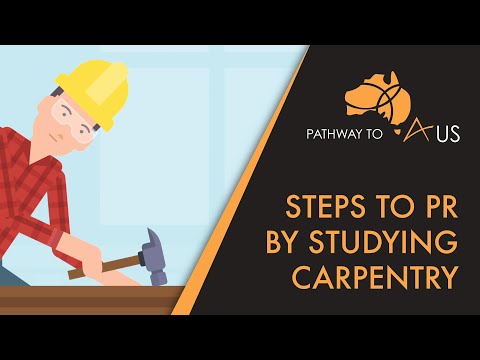
To obtain a positive skills assessment, the current qualification requirement is a Certificate III in Carpentry. Carpenter is assessed by Trades Recognition Australia (TRA). You may be able to apply for general skilled migration without employer sponsorship and without needing to live in a regional area.
Note: It is never recommended to engage in studies for the sole purpose of trying to gain a visa to Australia. Speak to us and we can find a course that matches your long-term career goals.
Step 1: Study a course or package of courses
Enrol in a course that trains you for a position on the Medium and Long-Term Strategic Skills List. You must complete at least 2 academic years (92 CRICOS weeks) of study in Australia, including 360 hours of vocational placement. Most education providers arrange vocational placement as part of the course.
- Certificate III in Carpentry (12-24 months)
Step 2: Receive the Temporary Graduate Visa
The Graduate Visa (Subclass 485) lets you remain in Australia for 18 months after finishing your studies. It is not points tested and does not require an employer sponsor. The Post-Vocational Education Work Stream is suitable for trade graduates such as carpenters. Apply within 6 months of receiving your final results. Many graduates use this time to build skills and meet requirements for permanent skilled migration visas.
Step 3: Participate in the Job Ready Program
The Job Ready Program (JRP) is a four-step employment-based skills assessment run by Trades Recognition Australia (TRA). You must complete at least 1725 hours of paid employment as a carpenter over a minimum of 12 months. Your employer will not need to sponsor your visa, as you will already be on the graduate visa. Once verified, you receive a positive skills assessment for general skilled migration. For more details, see the Job Ready Program page.
Step 4: Apply for a General Skilled Migration Visas
Once you have completed the Job Ready Program as a carpenter, you will receive a positive skills assessment. You may then be eligible to apply for General Skilled Migration visas: the Skilled Independent (Subclass 189), Skilled Nominated (Subclass 190), or Skilled Regional (Subclass 491). These visas do not require employer sponsorship. You will still need to pass the points test and health checks.
Your Visa Pathway (Step-by-Step)
Pathway: Student → Carpentry Course → Permanent Resident
Eligibility Check
We review your background, budget, and goals to see if studying a trade in Australia is a good fit and what realistic options you have.
1
Choose the Right Trade Course
Our consultants will then talk you through a range of study options that best suit your needs and develop a study path.
2
Plan Your Student Visa Application
We guide you through the student visa process and study plan so your documents and course choice support your long term goals.
3
Study, Work, Then Explore PR Pathways
You study your trade, gain local experience, then we map the next steps based on your results, location, and the options available at the time.
4
Start Your Study Journey the Smart Way
Book a free consultation to explore trade courses and your next steps in Australia.
Book a Consultation
Find Your Registered
Migration Agent
Connect with experienced migration agents who specialize in your visa type. Get expert guidance for student visas, work visas, permanent residency and more.






Find Your Migration Agent
Get matched with the perfect expert for your journey

Why Use Pathway to Aus?
Pathway to Aus has assisted thousands of students to study or migrate to Australia. We are here to support you throughout your journey and make the transition as easy and smooth as possible. Our experienced team of Education and Migration agents are ready to work with you to help you achieve your education and migration goals.
No cost to you
We’re a free service for students. We’re paid by the education institutes
Registered Migration Agents
Honest and accurate education and migration advice from registered Education and Migration agents
Ongoing support
We will provide you ongoing support throughout your migration journey.
Partnered with education institutes
Pathway to Aus has partnered with 100’s of education institutes across Australia
Real Students. Real Progress.
See how students planned their studies in Australia and built real careers through trade pathways.

Jade’s Pathway to Permanent Residency
In this video we meet Jade from the UK. Jade came to Australia with her partner and studied the Cert III in Carpentry. In Oct 2024, she was granted her permanent residency in Australia.

Rommel’s Pathway to Student Visa
“Pathway to Aus was with me every step of the way—thanks to their support, my student visa is GRANTED!“

Kimberly’s Student Visa Grant
“Pathway to Aus didn’t just help with my visa, they gave me the COURAGE to chase my dreams!“

Frequently Asked Questions
In case you don’t find an answer to your question, feel free to consult with one of our agents.
Where can I study carpentry in Australia?
International students can study carpentry in Adelaide, Brisbane, Gold Coast, Melbourne, Perth, Sunshine Coast, and Sydney.
How much will it cost to study carpentry in Australia?
The cost of studying carpentry can vary depending on the institute and ranges from $10,000 – $15,000 per year.
Can I do a carpentry apprenticeship in Australia?
International students can’t do a carpentry apprenticeship in Australia. Instead, they can study a 24-month vocational course to become a qualified carpenter. Click here to read more about apprenticeships and vocational courses for international students.
What qualifications do you need to be a qualified carpenter?
To be a qualified carpenter in Australia you need to successfully complete the Certificate III in Carpentry.
How long does it take to become a qualified carpenter?
To be a qualified carpenter, you must complete a Certificate III in Carpentry, a vocational course that spans 12-24 months.
What do you do as a carpenter?
A carpenter might do any of the following in a normal day:
- Reading and interpreting blueprints, drawings and sketches
- Building foundations, installing floor beams, laying sub-flooring and installing walls and roofing systems
- Fitting and installing trim, doors, stairs, moulding and hardware
- Preparing cost estimates for clients
- Measuring, cutting and joining materials made of wood or wood substitutes
- Repairing and renovating wooden structures
How much does a qualified carpenter make?
Carpenters and Joiners earn median full-time earnings of $1,760 per week (around $91,500 a year), according to Jobs and Skills Australia.
What qualifications do you need to obtain a builder’s licence?
The requirements for a builder’s licence vary from state to state in Australia. Generally, the academic requirements for a builder’s licence are to have successfully completed a Certificate IV or Diploma of Building & Construction.
Is carpentry in demand in Australia?
Carpentry is a trade that is currently on Australia’s Medium and Long-Term Strategic Skills List and the Core Skills Occupation List. This means that this occupation is highly in demand and is critical for the long-term economic growth of the country. Furthermore, the Australian Government Your Career reports that 84% of carpenters are in full-time positions and that there is a moderate future demand for this occupation.
Is carpentry physically demanding?
Carpentry work is physical and often physically demanding, involving tasks like lifting, standing for long periods, and using power tools. It requires good strength, stamina, and attention to safety.
What is the difference between carpentry & joinery?
The two are very similar, but there is a difference between the two. Carpenters are generally responsible for building the structure of a building, whilst a joiner would be responsible for much of the interior and finishing work.
What do I need to work as a carpenter in Australia?
To work as a carpenter in Australia you’ll need the following essentials:
- Tax File Number or Australian Business Number – Both of these are required for tax purposes. A TFN is needed if you’re employed by an organisation or company. An ABN is needed if you’ll be self-employed.
- Personal Safety Equipment – Steel cap boots, high visibility workwear, safety glasses, ear protection, hard hat, gloves
- Tools – Drills, hand & power saws, basic hand tools, finishing & nailing guns
- Construction Industry White Card – This is required to enter any building site and shows that understand the basics of health and safety in the construction industry
- Insurance – Depending on how you’re employed you may need public liability insurance
- Carpentry Qualification – You must have successfully completed a minimum of Certificate III in Carpentry to be a qualified carpenter
Are carpentry qualifications from Australia recognized internationally?
Yes, Australian carpentry qualifications are widely recognized internationally, especially in Europe and North America.
Australian carpentry qualifications are part of the Australian Qualifications Framework (AQF), a system that ensures a high standard of education and training. This makes them highly regarded in many countries, including those in Europe and North America, where Australian credentials are often accepted for work. However, specific recognition and licensing requirements vary by country, so it’s always a good idea to check the regulations in your home country or the country where you plan to work.
To learn more about carpentry courses in Australia and how they can help you achieve your career goals, visit Carpentry Courses in Australia.
What opportunities are there to progress after carpentry?
If you’d like to continue your studies after the Certificate III in Carpentry you can study a Diploma of Building and Construction (Building). This qualification can be helpful if you’re looking to continue your career as a project supervisor, building manager, estimator or foreperson.
How can I start a carpentry course in Australia?
To start a carpentry course in Australia, you must first enrol in a Certificate III in Carpentry. This certificate will provide students with the required skills to work in the building and construction industry in Australia and all over the globe. Common requirements for the course are:
1. Applicant must be 18 years of age or older.
2. Completion of Year 10 (or equivalent)
3. Be prepared to complete a 360 hour of vocational placement or work experience
4. English language evidence
If you complete this questionnaire we’ll be able to send you some detailed information on the course and explain what documents you’ll need for enrolment.
Related Resources
Explore more guides and alternative pathways to your Australian career

Articles, Videos & Pages
Related Courses
Not Sure Which Course Fits Your PR Goals?
Search our database to find accredited programs that match your qualifications and migration goals.
GET IN TOUCH
In case of questions, feel free to reach out to one of our experienced Registered Migration Agents.
Contact details
Give us a call
Australia: +61 7 5526 5900
Fiji: +679 922 3842
United Kingdom: +44 20 3948 3865


Send an email
info@pathwaytoaus.com
Gold Coast Office
2242 Gold Coast Highway,
Mermaid Beach, QLD, 4218
UK Office
5 Merchant Square
London, W2 1AY, United Kingdom
(By Appointment Only)