


If you have ever considered a career shift that truly makes a difference, then deciding to study nursing in Australia could be one of the most rewarding decisions you could make. The Australian health system is under pressure, with government modelling predicting a shortage of more than 70,000 full-time equivalent nurses by 2035. The demand for skilled and compassionate nurses grows year on year.
For years our team at Pathway to Aus have walked alongside international students as they convert ambition into life on Australian shores, watching quietly as nursing has risen to be one of the strongest, potentially most resilient pathways available today. The Master of Nursing at Southern Cross University has quietly grown in popularity with the students we work with, integrating academic rigour with real-world clinical practice in some of the most liveable places on the east coast.
Applicants to the two-year, full-time Master of Nursing (Graduate Entry) program at SCU must have a bachelor’s degree obtained within the last ten years with a minimum GPA of 5.0, and one 12-credit unit in human anatomy/physiology or a related discipline.
Key Takeaways
- Australia is a wonderful place to study nursing now with the country’s health system projected to be short of more than 70,000 full-time equivalent nurses by 2035.
- Southern Cross University offers a 192-credit, two-year Master of Nursing degree that includes 840 hours of clinical placement across the Gold Coast, Coffs Harbour and Lismore.
- International tuition fees are approximately AUD $36,000 per annum, plus OSHC, the AUD $29,710 student visa financial capacity requirement and placement costs.
- Graduates can investigate skilled migration channels and apply for the Temporary Graduate visa (subclass 485), albeit the results rely on their unique situation and the current policy.
Why Nursing in Australia Is Worth Considering
By 2030, Australia is projected to be short tens of thousands of nurses in the health system, so graduates should have no trouble finding jobs. Jobs and Skills Australia says the median weekly wage for registered nurses is AUD $2,192. The pay depends on the state, employer, penalty and experience. If you choose to specialise, the route to job progression is usually steady.
Recent SkillSelect invitation data and Australia's skilled migration settings still show a number of Registered Nurse occupations; however, eligibility for a visa is contingent upon the specific occupation, skills evaluation, and current visa regulations.
That inclusion matters because it links your qualification to a broader migration narrative that could open doors long after you graduate. There is so much diversity in this profession: mental health, geriatric care, community outreach, hospital wards.
Why Choose Southern Cross University
Southern Cross University nursing has built its reputation on its student outcomes, not on loud promotion. Accredited by the Nursing and Midwifery Board of Australia (NMBA), your degree will be recognised in every state and territory and consistently rated highly for student assistance and teaching quality.
In our perspective, the mix between academic rigour and practical clinical hours is what truly distinguishes SCU. Long before they graduate, students complete 840 hours of supervised Work Integrated Learning, which puts them in actual hospitals and community facilities. Stronger relationships with instructors are typically fostered by smaller cohort sizes, and this mentoring frequently continues into a graduate's first year of nursing practice.
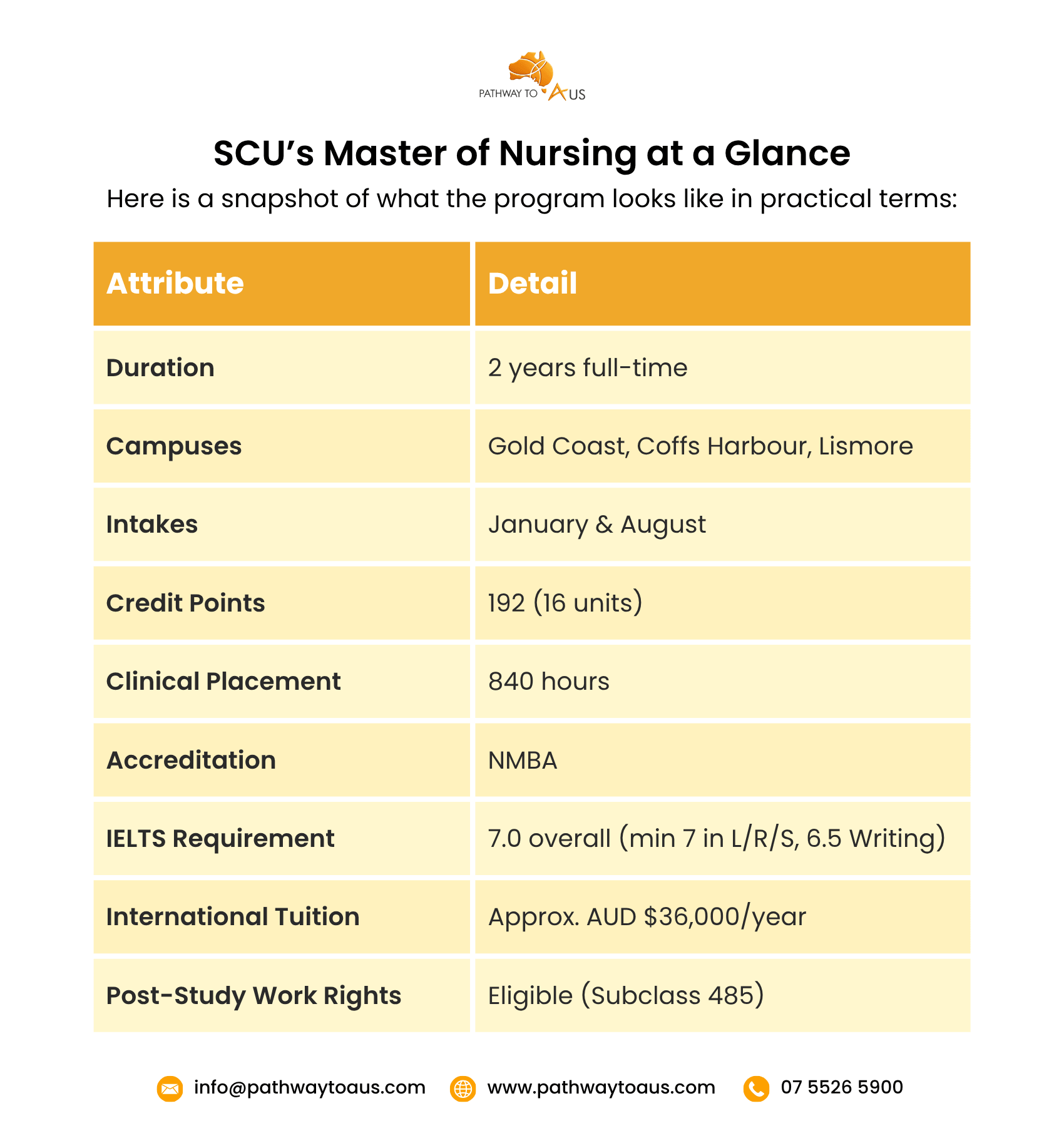
SCU’s Master of Nursing at a Glance
Here is a snapshot of what the program looks like in practical terms:
What You Will Study
Units in anatomy, physiology, pharmacology, and clinical evaluation throughout the first year lay the groundwork. It is designed to push students who already know the science while bringing those from non-health backgrounds up to speed.
In year two you will learn more complex clinical situations, mental health nursing, chronic care and a transition unit to prepare you for professional practice.
Over both years, clinical rotations will provide you with exposure to local, regional and sometimes rural health care settings. This variety often is one of the most talked about parts of student output.
Is Southern Cross University Nursing Good for International Students?
If you're wondering if nursing at Southern Cross University is a good fit for international students, the truth is that, for the appropriate individual, it is. Smaller cohorts, coastal living, robust clinical placement systems, and a more individualised approach to education are all characteristics of successful SCU students.
It suits you well if:
- You hold a bachelor's degree in any discipline
- You can achieve IELTS 7 with strong writing
- You want a potential two-year route towards Registered Nurse eligibility
- You are open to regional living in NSW or QLD
Entry Requirements You Should Know
To enrol in the Master of Nursing Australia offers at SCU, you will need a completed bachelor's degree in any field. That flexibility is one of the reasons the program suits career changers so well. Whether your background is in business, teaching, or hospitality, your existing degree may still open this door.
Applicants must meet SCU’s English-language admission requirements and later meet AHPRA/NMBA English-language requirements for registration; IELTS Academic is one accepted pathway, but other accepted tests and some education/language pathways may also qualify.
This dual gate is a common reason students come to us for pre-application coaching, and we often recommend giving yourself extra time to prepare for the writing component, which trips up more applicants than any other section.
You will also need to meet inherent requirements, which cover the physical, cognitive, and communication demands of clinical practice. Immunisations, First Aid certification, and background checks come into play before placements begin.
IELTS Preparation Support for Aspiring Nurses
Practical strategies to hit the 7.0 threshold across all four IELTS bands.
How to Apply
The application journey typically looks like this:
- Confirm you meet entry requirements
- Gather academic transcripts, IELTS results, and identification
- Submit your application online or through a registered education agent
- Receive your offer and pay your deposit
- Apply for your Student Visa (Subclass 500)
- Enrol and prepare for arrival
We generally recommend applying six to nine months before your chosen intake, because places fill quickly; especially at the Gold Coast campus.
Choosing Your Campus
Southern Cross University offers Master of Nursing programs at its Gold Coast, Coffs Harbour and Lismore campuses. Each of the three campuses of SCU has individual personality, and where you study could affect more than your commute:
- The Gold Coast is ideal for people who seek the vibrancy of the beach combined with close access to big hospital networks.
- Coffs Harbour is a more chilled out beach town with a close student community.
- The main campus, Lismore, is located in a natural environment and is near to Byron Bay in the lush Northern Rivers region.
Students think hard about the costs of living, which are different from place to location. We frequently guide applicants through this decision in our consultation sessions.
Understanding the Real Cost
Let's talk honestly about Master of Nursing fees that students actually pay in Australia.
SCU lists 2026 international tuition at AUD $36,000 per year, or AUD $4,500 per unit; at the standard 16-unit course load, that totals about AUD $72,000 over two years, subject to future fee changes. That places the Master of Nursing outside of SCU's Access26 pricing scheme, which applies to most other courses.
Beyond tuition, you should plan for:
- Health coverage for overseas students is about AUD $700 per year.
- On May 10, 2024, the Department of Home Affairs raised the principal applicant's financial capacity for a student visa from AUD $24,505 to AUD $29,710.
- Textbooks, uniforms, and placement travel: About $1,500 to $2,500 AUD
While it isn't the cheapest program on the market, when weighed against career outcomes and post-study pathways, many of our students consider it strong value. For those searching for affordable nursing programs Australia offers, we help clients look at scholarships, payment plans, and living cost strategies that make the numbers work.
Guide to Living in Regional Australia as a Student
Learn about everyday living in the Gold Coast, Lismore, and Coffs Harbour.
From Graduate to Registered Nurse
Once you complete the Master of Nursing at SCU, your next step is registering with AHPRA through the NMBA. Because the program is nationally accredited, this pathway is designed to be streamlined for graduates who meet all English language and inherent requirements. Most graduates are eligible to apply for AHPRA registration and can practise in diverse healthcare settings.
The Migration Pathway
This is where nursing can potentially open doors. If you meet Home Affairs standards you may be eligible for the Temporary Graduate visa (subclass 485) Post-Higher Education Work stream. This visa normally allows you to stay for two to three years, depending on qualification.
From there, the nursing PR pathway Australia offers may include:
- Skilled Independent Visa (Subclass 189)
- Skilled Nominated Visa (Subclass 190)
- Skilled Work Regional Visa (Subclass 491)
Many overseas students see nursing as a good career and migration option as registered nurse vocations are listed in the latest federal SkillSelect invitation data. However, the approach should be carefully planned rather than assumed because migration outcomes rely on individual circumstances, current government policy, and skills assessments through ANMAC.
This is where much of our advisory work quietly takes shape — mapping realistic timelines, identifying regional opportunities, and preparing skills assessment documentation well before graduation, so nothing feels rushed when the time comes.
Skills Assessment Support for Nurses
Our tailored service to help nursing graduates prepare their ANMAC skills assessment with confidence.
The Pathway to Aus Advantage
In Australia, deciding to be a nurse is more than an academic option, it’s a life choice. All your choices, from selecting the right campus to being ready to apply for a visa, affect your experience.
This is exactly the type of trip our team was meant to help you with. Helping you determine your eligibility, preparing your documentation and giving you continuous migration and education support that suits your unique situation rather than a one-size-fits-all approach.
If you are willing to continue, we would be glad to hear from you. Schedule a consultation with our team today and we’ll help you take one step closer to your dream of becoming a nurse in Australia.
Frequently Asked Questions
How long does it take to become a registered nurse in Australia?
While entry programs for non-nursing graduates, like SCU's Master of Nursing, normally take two years, a Bachelor of Nursing typically takes three to four years full-time. Before practicing, graduates of recognised programs must register with AHPRA through the NMBA.
Can international students work while studying nursing in Australia?
Student visa holders are generally permitted to work part time during term and full time during scheduled breaks, subject to current Department of Home Affairs restrictions associated with the Subclass 500 visa. Paid labour entitlements are often not counted as clinical placement hours.
What is the difference between a Bachelor of Nursing and a Master of Nursing pathway in Australia?
The Master of Nursing (Graduate Entry) is for people who already have a bachelor's degree in any field and want to become registered nurses more quickly. The Bachelor of Nursing is for high school graduates who have little or no college experience. Either way, graduates who meet the standards for accreditation and placement may be able to get registered with AHPRA.
Do you need IELTS to study nursing in Australia?
Most universities want you to have an IELTS Academic score of at least 7.0 overall, with at least 6.5 in each band. However, some English tests and pathway programs may also be accepted. In the end, AHPRA and NMBA also have different English language needs.
Which Australian cities are best for international nursing students?
Sydney, Melbourne, Brisbane, and the Gold Coast are all popular places to study. Regional areas like Lismore and Coffs Harbour are also good options because they have smaller cohort sizes and easy access to clinical placements. The right choice is often determined by lifestyle preferences, cost of living, and how close the area is to hospital networks.