


If you are interested in the Australia 189 visa, you are already looking at one of the best ways to become a permanent resident. It's still a popular choice because it gives skilled applicants permanent residency without the need for a company to sponsor them. This means they can build their future in Australia on their own.
That opportunity is exactly why planning matters. The best results are generally seen from applicants who see the 189 as one part of a bigger plan, not the only way to go.
Pathway to Aus helps people who want to move to Australia and need a clear plan that can be changed as opportunities arise. Though your 189 visa grant hasn't come yet, that doesn't mean you have to wait. It usually means it's time to make your case stronger, improve your documents, and find more than one way to get PR.
We've seen that taking a bigger picture gives you more freedom, confidence, and often more speed.
Why the Australia 189 Visa Remains So Appealing
We understand why the 189 gets so much attention. It is one of the most well-known ways to move to a new country through General Skilled Migration because it lets you live there permanently without having to work for someone else.
For a lot of applicants, being independent is a big plus. It gives you the freedom to live and work in Australia and build your career the way you want. Still, waiting isn't usually a part of a good 189 strategy. At the same time, a strong 189 strategy is rarely just about waiting.
It works best when everything around your application is aligned and ready to move. That usually means reviewing your:
- Expression of Interest (EOI)
- Points calculation
- Skills assessment
- Work history evidence
- Supporting documents
When we help clients prepare for skilled migration, we focus on getting those details right early. That creates a stronger foundation not only for the 189, but also for the other pathways that can sit alongside it.
A Smart Strategy Includes Alternatives to 189 Visa Pathways
One of the biggest advantages in migration planning is having options. When we build a strategy with you, we do not look only at one invitation stream. We look at where your occupation, location, experience, and timing may create the best overall opportunity.
That is why alternatives to 189 visa pathways matter so much. In many cases, they are not second-best options at all. They are simply different routes within the same broader objective: creating a practical and well-positioned path to Australian permanent residency.
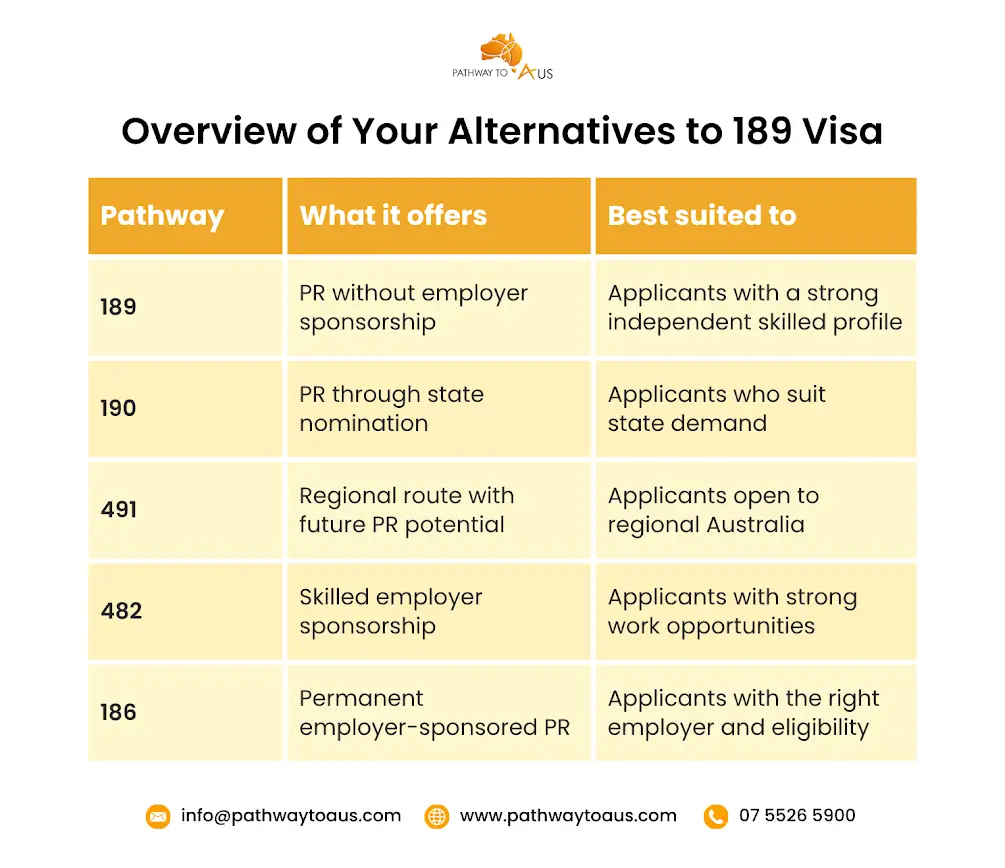
The most common pathways we compare are:
- the 190 visa pathway
- the 491 visa pathway
- Employer sponsorship via 482 Skills in Demand visa
- Permanent employer sponsorship via the 186 visa
Each route has something different to offer. In order to choose, you should know the following:
Not sure which visa is right for you?
From skilled pathways like the 190 and 491 visas to employer-sponsored options such as the 482 and 186, the right visa depends on your occupation, eligibility, and long-term goals in Australia. Speaking with a registered migration professional can help you understand your options and choose the pathway that best fits your circumstances.
190 Visa Pathway: Strong for Applicants who Suit State Nomination
The 190 visa pathway approach is often a natural next step for applicants who want permanent residency and suit state nomination settings. The 190 is a permanent skilled nominated visa, it does not require employer sponsorship, and it gives approved applicants PR from grant.
What makes the 190 especially useful is that it adds a state-based layer to your strategy. Instead of relying on one national invitation route, you can also position yourself for nomination from a state or territory whose needs align with your profile.
When we assess a 190 strategy, we usually look at whether:
- Your occupation is being nominated in the right state
- Your points are competitive there
- Your work or residence history strengthens your case
- Your documents are ready to support quick action
This is where careful positioning can make a real difference. A well-targeted 190 application often gives you a more purposeful direction, especially when your profile matches a state’s priorities at the right time.
The Move That Changed Wayne’s PR Future
Read Wayne’s story to see how a chef’s pathway to permanent residency took shape through the 190 visa, after a strategic move from Victoria to Western Australia. His experience shows how timing, state nomination, and the right migration advice can make all the difference when planning a future in Australia.
491 Visa Pathway: Regional Opportunities with Long-term Potential
The 491 visa route can be a great fit for people who are willing to live in regional Australia and want to make a structured long-term plan to become permanent residents.
With the 491 visa, skilled workers and their families can live, work, and study in certain regional areas for five years. If the requirements are met later, the Subclass 191 visa could lead to permanent residency.
We think the 491 is a good, forward-looking choice because regional Australia keeps making real jobs available for skilled people. For many, it's a useful way to get experience in Australia, make a name for themselves there, and keep working toward PR.
In general, this path works best when you are happy with:
- living in a designated regional area
- building your career in regional Australia
- meeting the income and residence requirements over time
When regional living suits your goals, the 491 can become far more than a backup. It can become the pathway that gives your migration strategy shape and direction.
From Customer Service to the Workshop Floor
Read Louis’s experience to see how he went from working in customer service in India to studying automotive on the Gold Coast, with hands-on workshop training and big plans for the future. His story gives readers a practical look at student life, vocational placement, and what it’s really like to build a career in the automotive industry in Australia.
Employer Sponsorship Can Add Real Momentum
Another strong pathway is employer sponsorship. For applicants already building their career in Australia, or for those in occupations with solid labour demand, sponsorship can create meaningful progress and a very practical route forward.
Through the 482 Skills in Demand visa, Australian employers can sponsor skilled workers where suitable local candidates cannot be found. We like this route because it can help you establish yourself professionally while also building longer-term migration options. It may also support a later move towards permanent residency if the criteria are met at the time.
A 482 strategy can be attractive because it may offer:
- full-time skilled employment
- family inclusion for eligible applicants
- stronger Australian work experience
- a clearer professional pathway
For some applicants, that sponsored foundation can later support the 186 visa, which is a permanent employer-sponsored pathway. The 186 visa has three streams: Direct Entry, Labour Agreement, and Temporary Residence Transition.
How Marko Turned Passion into a Future in Australia
Read Marko’s story to discover how studying commercial cookery in Tasmania helped him build new skills, find work, and move toward employer sponsorship. His experience offers an inspiring glimpse into how determination, the right support, and a clear goal can open doors to a long-term future in Australia.
Education Can Also Become Part of a Positive Long-term Plan
In some cases, the most promising pathway is not just about changing visas. It is about building the right qualifications for where Australia’s skill demand is heading. That is where the Educate to Migrate approach becomes valuable.
Together, we look at study, job, location, and migration because the right course can do more than just give you a qualification. Making you more employable, putting you in a field that people want, and giving you access to new skilled or sponsored jobs over time are all benefits of volunteering. It's easier to feel confident about moving when you choose your education carefully.
After Years of Setbacks, Steven Finally Reached PR
Read Steven’s story to follow a long-term migration journey that eventually led to permanent residency through the 186 visa. His experience is a strong reminder that with persistence and the right guidance, a successful outcome is possible.
Want to know where you fit in the 2026–27 Migration Program?
Australia’s migration program continues to evolve, and the best pathway is not the same for everyone. A personalised assessment can help you understand which visa options suit your occupation, work experience and long-term goals.
Why a Broader Strategy Creates Stronger Opportunities
At Pathway to Aus, we see skilled migration as a good thing because there isn't usually just one way to get there. When you work with us, we look at everything and help you make a plan that gives you options. For example, you could work on your General Skilled Migration profile, try to get a 190 visa, look into a 491 visa, or get things moving along with the 482 or 186.
The job of our company is to help you see those chances clearly, get ready, and move forward with confidence. If you need personalised help, our qualified migration agents can look at your goals, see if you are eligible, and help you figure out the best next step for your PR journey.
We can help you figure out what to do if you missed your 189 visa invitation. Book a consultation today.
Frequently Asked Questions
What is the Australia 189 visa?
As a skilled worker, the Australia 189 visa lets people who are invited to live and work in Australia permanently without a company sponsoring them. This route is one of the most popular ways to move as a general skilled worker because it gives you freedom and lasting residency from a grant.
How many points do you need for a 189 visa?
To be invited to apply for a subclass 189, 190, or 491 visa, you need at least 65 points. However, just meeting the minimum requirement does not mean you will be invited. In real life, competitive scores can change based on your job, the trend of invitations, and the overall demand. That's why having a good plan is just as important as meeting the minimum requirement.
Is 65 points enough for a 189 visa?
You need at least 65 points to be asked to apply for a subclass 189, 190, or 491 visa, but invitations are given based on occupation and competition in each round. That's why a lot of applicants make their case stronger by also looking at company sponsorship or state nomination.
What are the best alternatives to the 189 visa?
Most of the time, the 190 visa pathway, the 491 visa pathway, and employer-sponsored choices like the 482 Skills in Demand visa and the 186 visa are used instead of the 189 visa. Because each path is better in some situations than others, the best choice for you will depend on your job, points, location, and long-term goals in Australia.
What is the difference between the 189, 190, and 491 visas?
The 189 visa is a skilled worker immigration visa that can be used by anyone; an employer or state sponsor is not needed. The 190 visa is a skilled worker visa that is valid for life and is given by state or territory nomination. The 491 visa is a regional skilled visa that lets you live and work in certain regional places. There may be a way for you to become a permanent resident in the future.
Does the 491 visa lead to permanent residency?
Yes, the 491 visa may lead to permanent residency through the 191 subclass, as long as you meet the requirements at the time. In a broad sense, this means having an eligible visa for at least three years, following the rules of the visa, and giving the ATO letters of assessment for three income years; there is no minimum income requirement.
Do you need an EOI for the 189, 190, and 491 visas?
Yes, an Expression of Interest is a very important part of skilled relocation. For these paths, you usually use SkillSelect to send your EOI and then wait to be invited to apply. For the 190 and 491, nomination is also a part of the process.
Can employer sponsorship be a better pathway than waiting for a 189 invitation?
For a lot of people, yes. Employer sponsorship is a great way to get things going, especially if you already have a job in Australia or if your job is in high demand. The 482 Skills in Demand visa can help you get a job, and in some cases, it can help you move on to the permanent 186 employer-sponsored visa later on.