


Driven to Work
From Course Study to Employment to Permanent Residency
It's Heavy Diesel vs. Light Vehicles --- the road to becoming a Mechanic in Australia has a lot to do with specialised skills, diagnostics, and safety awareness for both heavy diesel vehicles as well as light vehicles. A way to know which road to take is by exploring what the courses offered and what you can learn from them. If you’re thinking about whether to study the Heavy Diesel Mechanic course or a Light Vehicle Mechanic course, we’re sharing information that could help you on your journey to — from education to migration.
🟠 Take a deeper dive: Choosing an automotive course
Application ≠ Approval
This is a gentle reminder to note that a visa application doesn’t mean approval. If you follow the process and submit all the requirements, getting a visa grant is possible.
Heavy Diesel Mechanic
Certificate III in Heavy Diesel Mechanic
The Student Experience
- Workshop
- Theory + practical assessment
- Learning by doing through hands-on training
Topics you’ll be learning about
- Diesel engines (fuel systems, turbochargers, cooling)
- Braking systems (air brakes are a big one)
- Steering, suspension, and driveline systems
- Hydraulics and pneumatics
- Electrical and electronic diagnostics
- Workplace safety and compliance
Skills learned
- Mechanical and problem-solving skills
- Capability to use software and tools
- Dexterity, stamina
- Detail-orientedness and awareness of safety
- Effective communication and collaboration
These are also skills that stand out when looking for work in the automotive industry.
Course Program
Workshop (Application of theory)
- Trucks, buses, or heavy vehicle components
- Engines and other mechanical parts
- Scanners and other tools or equipment
Assessments
- Actual and practical demo
- Observations by teachers
- Written questions
- Proof of work / logbooks
Costs & Equipment/Gear
- PPE
- Basic equipment / tools
- Textbooks or online resources
- White card (safety certifications)
Challenges + honing skils
Student Challenges
- Technical and specialised language
- Fatigue
- Adapting to an Australian workplace (for international students)
This course prepares you for
- Specified and specialised automotive training
- Experience with heavy vehicles is done through hands-on training
- Qualification that’s nationally recognised
- Employment is strongly possible
Working as a Mechanic
- Entry-level qualified mechanic: est AUD70,000+ per year (depending on company and location)
- Experienced mechanics: est AUD80,000–AUD100,000+
- Mining/rostered roles: some heavy diesel jobs in mining can reach well into 6 figures (especially with overtime and FIFO rosters).
🟠 Learn more: Working as a Heavy Diesel Mechanic
Recap
- Diesel Motor Mechanic (heavy diesel) is on the MLTSSL.
- To be able to attain employment, there needs to be qualifications + skills assessment.
- Visas that can lead to PR are 189, 190, 491 (points-based General Skilled Migration visas) or (186) (Employer-sponsored visa).
- There’s focus on work experience, documentation, and English proficiency.
Trade course consultation is possible here at Pathway to Aus.
Ready to enrol? Start here.
Light Vehicle Mechanic
Certificate III in Light Vehicle Mechanic
The Student Experience
- Workshop
- Theory + practical assessment
- Learning by doing through hands-on training
Topics you’ll be learning about
- Engine management systems
- Braking systems (hydraulic, ABS, stability control)
- Steering and suspension
- Electrical systems & diagnostics
- Air conditioning systems
- Workplace safety and compliance
Skills learned
- Keen diagnostic thinking
- Good handle and use of scan tools and software
- Detail-orienteness
- Management of time
- Effective customer communication
Course Program
Workshop (Application of theory)
- Service and inspections (engine, air conditioning, road safety)
- Diagnosing engine and making repairs
- Electrical and electronic diagnosing
- Reporting issue diagnosis to customers
Assessments
- Actual and practical demo
- Mastery of subject matter (knowledge questions either written or online)
- Checklists (observations)
- Proof of work / logbooks
Costs & Equipment/Gear
- PPE
- Basic equipment / tools
- Textbooks or online resources
- White card (safety certifications)
- Certification for AC handling certification
Challenges + honing skils
Student challenges
- Understanding wiring diagrams
- Engine management theory
- Logic-based diagnoses
- Mastery of procedures and specs
This course prepares you for
- Independently working on light vehicles (service and repair)
- Giving diagnoses of mechanical and electrical issues
- Clear communication in a workplace setting
- Adapting to an Australian workplace (for international students)
Working as a Mechanic
- Entry-level qualified mechanic: AUD60,000–AUD70,000
- Experienced mechanics: ~AUD70,000–AUD90,000
- Specialists or Master Techs: have higher earning capabilities
🟠 Discover more: Starting a career with an automotive mechanic course
Recap
- Light Vehicle Mechanic (light vehicle) is on the MLTSSL.
- To be able to attain employment, there needs to be qualifications + skills assessment.
- Visas that can lead to PR are 189, 190, 491 (points-based General Skilled Migration visa) or (186) (Employer-sponsored visa).
- There’s focus on work experience, documentation, and English proficiency.
Trade course with a student visa consultation is possible here at Pathway to Aus.
Educate to Migrate | As a Mechanic in Australia
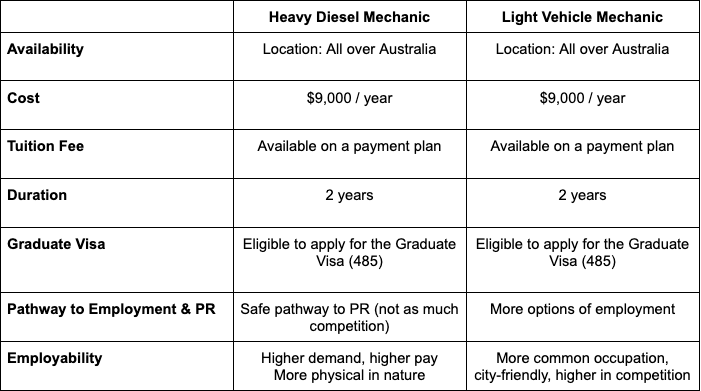
A few possible pathways for both occupations:
Study → Cert III → Work → TRA → Employer sponsorship (482) → PR (186)
or
Study → Work → TRA → Regional nomination → 491 → PR
For both occupations, the general work includes:
- Making use of scan tools
- Checking transmission, brakes, engine, suspension
- Electrical fault-finding
- Safety standards check & documentation
PR Prospects
Visa options that lead to PR
Study
- Temporary Graduate Visa (485)
Can stay in Aus for 2-4 or more years after graduation for work experience as a bridge to PR
- Skilled Independent Visa (189)
Not sponsored by employer, it’s a visa for skilled workers that’s points-based
- Skilled Nominated Visa (190)
Points-based visa that is permanent and requires a nomination by a state or territory government in Australia
- Skilled Work Regional (491)
Points-based visa that enables skilled workers to live and work in regional Australia with a possible pathway to PR
- Employer-sponsored visa (186)
Company-sponsored visa that gives skilled workers the opportunity to live and work in Australia
If there’s more information that you need, you can always feel free to Contact Us and one of our lead migration agents can help you through the process.