

Reviewed against Department of Home Affairs information on 15 October 2026.
Student visa rules changed on 2 October 2026. Most temporary visa holders now apply from outside Australia, and including family is more limited. Here are the five questions students ask most, answered with current Home Affairs information.
Key Takeaways
- Holders of listed temporary visas, including Temporary Graduate (485) and Visitor (600), apply for a Student visa (subclass 500) from outside Australia. No exemptions apply to this group.
- Family members are generally not included in a new Student visa application or added after the visa is granted. Some exemptions apply when you apply.
- The Student visa application charge starts from AUD2,500.
- AUD29,710 is the 12-month living-cost amount for a student. You also show funds for travel, course fees and, if relevant, school fees.
- A Student visa may be granted for up to 6 years, depending on your course.
- Permanent visa options after study, such as the 189, 190 and 186, each have their own requirements.
Check which rules apply to you
Your options depend on your current visa, your course and who is travelling with you. Our education agents can talk through your situation. Book a free education consultation.
1. What are the new rules for Student visas in Australia?
The new rules started on 2 October 2026. They apply to applications lodged from that date. Earlier applications are assessed under the rules in place when they were lodged. For more details, see our guide to the 2 October changes.
| Topic | What applies from 2 October 2026 |
| Where to apply | Most Student visa applications are lodged from outside Australia. |
| Temporary Graduate (485) and Visitor (600) holders | Holders of these visas apply for a Student visa from outside Australia. The same applies to holders of Working Holiday (417), Work and Holiday (462), Skills in Demand (482) and other visas on the Home Affairs list. No exemptions apply. |
| Current Student visa holders | A further Student visa can be lodged in Australia only if an exemption applies. Examples are needing up to 12 more months with the same provider, PhD study, school study, moving to a higher AQF level, DFAT or Defence sponsorship, or provider default. |
| Family members | Family members are generally not included in an application or added later. Exemptions at application include PhD students, DFAT or Defence sponsored students, full foreign government scholarship holders, and nationals of Pacific Island or ASEAN countries. |
These settings also apply:
- Genuine Student requirement: You show that studying is your main reason for coming to Australia. Home Affairs explains the criteria.
- Work hours: You may work up to 48 hours a fortnight while your course is in session. Students in a master’s by research or doctoral degree have no work limit.
- Planning level: The Australian Government set a National Planning Level of 295,000 new overseas student commencements for 2026.
- Processing priority: Applications lodged outside Australia are processed under Ministerial Direction 115, in Priority 1, 2 or 3; and are based on provider allocation and course type. Processing speed and allocation are governed. It does not decide whether a visa is granted.
Studying with family or changing visas?
Rules on family and applying from inside Australia depend on your visa and course. A registered migration agent can review your situation. Book a migration consultation.
2. What are the requirements for a Student visa (500)?
Home Affairs sets the requirements for the Student visa (subclass 500). Most applicants need the same core items: an enrolment, English evidence, enough funds and health cover. The exact documents depend on your passport country, your education provider and your circumstances. This table gives the main points:
|
Requirement |
What you need to know |
|
Enrolment |
You need a valid Confirmation of Enrolment (CoE) for a full-time course registered on CRICOS. If you study more than one course, you need a CoE for each course you plan to take. An offer letter alone is not enough. |
|
You show that studying in Australia is your main reason for applying. A statement alone is not enough. You attach evidence about your study history, any changes of course or provider, your work history and your future plans. Read the Home Affairs criteria. |
|
|
The usual minimum is IELTS 6.0 overall, or an approved equivalent. The minimum is 5.5 if your course includes at least 10 weeks of ELICOS or an eligible foundation or pathway program. It is 5.0 with at least 20 weeks of ELICOS. Your test must be recent. Take it within two years before you lodge, or within two years before a decision if Home Affairs asks for it. Some applicants are exempt. Check English options. |
|
|
Funds |
You show enough money for your stay. The amount and the accepted evidence depend on your situation. See question 3 for the figures, then check the Document Checklist Tool. |
|
Health and character |
Health examinations and police certificates depend on your nationality, location, course and personal circumstances. The Document Checklist Tool shows which apply to you. |
|
Health insurance |
You need Overseas Student Health Cover (OSHC) for yourself and any family members who come with you. Cover must last for your whole stay. If you apply from outside Australia, it must start on the day you arrive. This is generally 1 week to 1 month before your course starts. |
|
Documents and lodgement |
The Home Affairs Document Checklist Tool lists the evidence for your circumstances. This includes a valid passport and academic records. You apply online through ImmiAccount. |
Application ≠ Approval
Home Affairs assesses each application against the requirements that apply at lodgement. Meeting the requirements does not guarantee a visa grant.
3. How much is the Student visa fee for Australia?
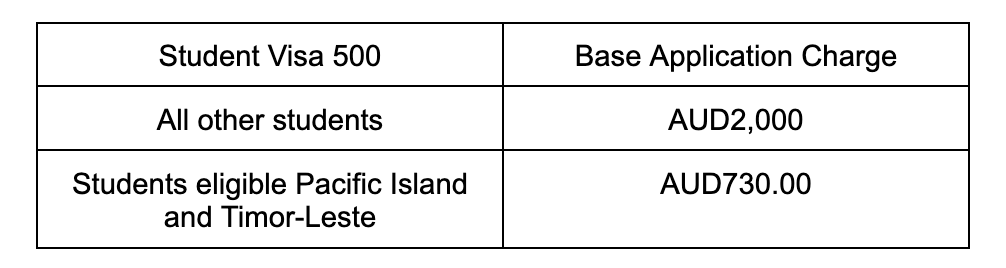
The visa costs from AUD2,500 for the main applicant. Lower charges apply in limited circumstances. There is also a charge for each family member who applies. Health checks, police certificates and biometrics may cost extra. The Home Affairs Visa Pricing Estimator shows the amount for your situation. This section covers both, so you can plan your budget before you apply.
|
What |
What to know |
|
Visa application charge |
From AUD2,500 for the main applicant. Lower charges apply in limited circumstances. |
|
Family members |
There is a charge for each family member who applies. |
|
Other costs |
Health checks, police certificates and biometrics may cost extra. |
|
Travel |
Show you have enough money for your travel to Australia. |
|
Course fees |
Show you have enough money for 12 months of course fees. |
|
Living costs |
Show you have enough money for 12 months of living costs. See the amounts below. |
|
School fees |
Show you have enough money for school fees if you bring school-age children. |
The Home Affairs Visa Pricing Estimator shows the exact charge for your situation. The living-cost part of the funds requirement is:
|
Who |
12-month living costs |
|
Student |
AUD29,710 |
|
Partner (if included) |
AUD10,394 |
|
Child (if included) |
AUD4,449 |
Estimate your funds
Not sure how much money to show? Our calculator gives an estimate based on your course and family size. Try our financial capacity calculator.
4. How long can you stay with a Student visa?
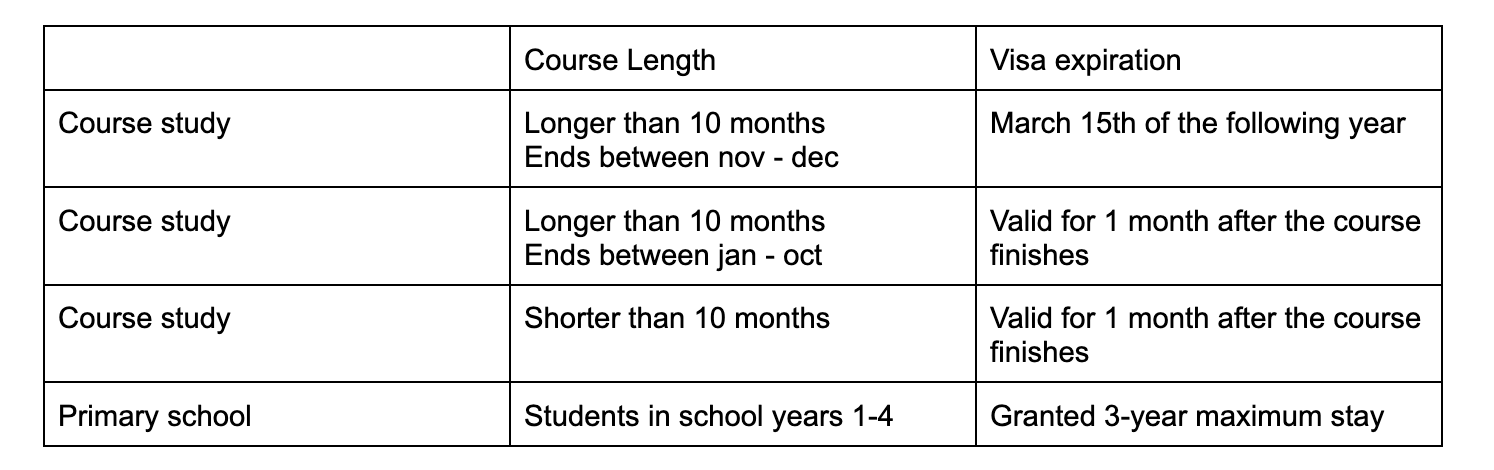
A Student visa may be granted for up to 6 years. Length depends on your course type and length, and on your OSHC cover.
- Courses of 10 months or longer that finish between January and October usually get 2 months beyond the course.
- Courses of 10 months or longer that finish in November or December usually run to 15 March the next year.
- Courses under 10 months usually get 1 month beyond.
- Tertiary students generally receive up to 5 years. Packaged courses with clear progression may reach 6.
Your visa end date cannot be changed once granted, so match your OSHC to the stay you need. A further Student visa may be possible. Since 2 October 2026, applicants in Australia need to meet an exemption.
Ready to enrol? Start your journey here.
-
Find a course or browse our trade courses.
-
Fill out the PTA Enrolment Form. It takes about 5 to 10 minutes.
-
Questions first? Book a free education consultation.
5. Can I apply for PR after studying in Australia?
Some graduates explore permanent visa options after study. Each visa has its own requirements, and eligibility depends on your circumstances.
- Temporary Graduate visa (485): A temporary visa for recent graduates aged 35 or under. The Post-Vocational Education Work stream allows up to 18 months. The Post-Higher Education Work stream usually allows 2 to 3 years, depending on your qualification.
- Skilled Independent visa (189): A points-tested permanent visa with no employer or state sponsor.
- Skilled Nominated visa (190): A points-tested permanent visa that needs a state or territory nomination.
- Employer-sponsored visa (186): A permanent visa where an employer nominates you.
Estimate your points score
Points are one part of skilled visa eligibility. Our calculator estimates your score for the 189, 190 and 491 visas, which may help you plan your next steps after study. Try our points calculator.
What to Do Next
Student visa rules can change, and each situation is different. Your visa, course, family and long-term plans all affect which options may suit you.
If you would like to talk it through, our registered migration agents can review your circumstances and explain the next steps. Speak with a Pathway to Aus migration agent.
Sources: Department of Home Affairs, Student visa (subclass 500), Changes to Student visa application rules, Temporary Graduate visa (485), Student visa processing priorities. Department of Education, A managed system for international education.