


If you are thinking of studying painting and decorating in Australia, you probably imagine something between a trade school and a construction site. That hunch is more correct than most course brochures would have you believe. This is a hands-on qualification, not purely a lecture, and that makes all the difference to the way you’ll spend your week, and how prepared you’ll feel when you step onto a real job site after.
Matching international students to the right Australian course, and later the right visa pathway, is what we do at Pathway to Aus. Painting and decorating comes up a lot. It's steady work, hands-on, and may lead you somewhere. Here's what the Certificate III in Painting and Decorating course really involves, and how to go in prepared.
Key Takeaways
- Certificate III (CPC30620) is primarily taught in a workshop instead of a lecture room.
- You acquire practical skills throughout the training, such as surface preparation, application techniques, colour theory, and workplace safety.
- As important as the course material itself is selecting the appropriate certified training organisation based on amenities, class sizes, and assistance.
- Visa and migration outcomes depend on individual circumstances and changing policy, so it's worth treating the qualification as a genuine trade investment first.
- Pathway to Aus supports students from course selection through to skills assessments and visa guidance.
What the Qualification Covers
The Certificate III in Painting and Decorating (CPC30620), which is available nationwide through registered training organisations (RTOs), is the main credential.
During your academic career, you will likely encounter:
- Sanding, filling, and priming various substrates are examples of surface preparation.
- Methods of application for spray, roller, and brush finishes
- Proper use and upkeep of tools and equipment
- Colour theory and basic decorative finishes
- Workplace health and safety standards specific to painting sites
You will get to learn each of these skills in a workshop intended to replicate a real trade environment.
Why the Hands-On Model Matters
Vocational trades rely heavily on hands-on learning for a reason that goes beyond tradition. Painting and decorating are crafts that you develop with practice. Instead of reading about it, you should observe how paint works on plasterboard as opposed to wood. You learn to judge when a wall is properly prepped by running your hand over it, again and again, until the difference becomes obvious without thinking.
For this reason, "learning by doing" has become something of a catchphrase in trade education. We would advise you to check for this concept when comparing training companies.
Instead of producing graduates with theoretical knowledge they haven't yet tested, a school that puts you in a workshop, working with actual tools on real surfaces, tends to produce graduates who enter their first job with genuine confidence.
For international students especially, this matters greatly. You're not merely picking up a skill, you're studying it in a foreign nation, in a second language, and in an environment with strange workplace customs. While those may seem like minute matters, they play an important role for students like you.
What the Training Environment Should Feel Like
Good painting and decorating workshops share a few common features worth checking for when you're comparing courses. Some of the best tips include:
- Look for facilities that mirror real trade conditions: proper ventilation, a genuine range of surfaces and substrates to practise on, and enough equipment that you're not queuing for a spray gun.
- Small class numbers also tend to be beneficial because they allow trainers to provide more one-on-one technique correction, which is where the majority of actual learning takes place.
- The culture of the space is equally significant. Long practical sessions when you're troubleshooting the same difficulties as your classmates foster a strong sense of camaraderie, according to students who have completed these programs.
A friendly cohort and supportive teaching staff can make a real difference in how quickly international students settle in and start enjoying the work. When comparing course outlines, it's simple to ignore the social component, but it influences your daily experience more than nearly anything else.
How to Work as a Painter and Decorator in Australia
Career prospects, salary and visa pathway overview.
Choosing the Right Training Provider
It's important to do some research before enrolling because not all RTOs provide painting and decorating instruction at the same level. A few things to look at:
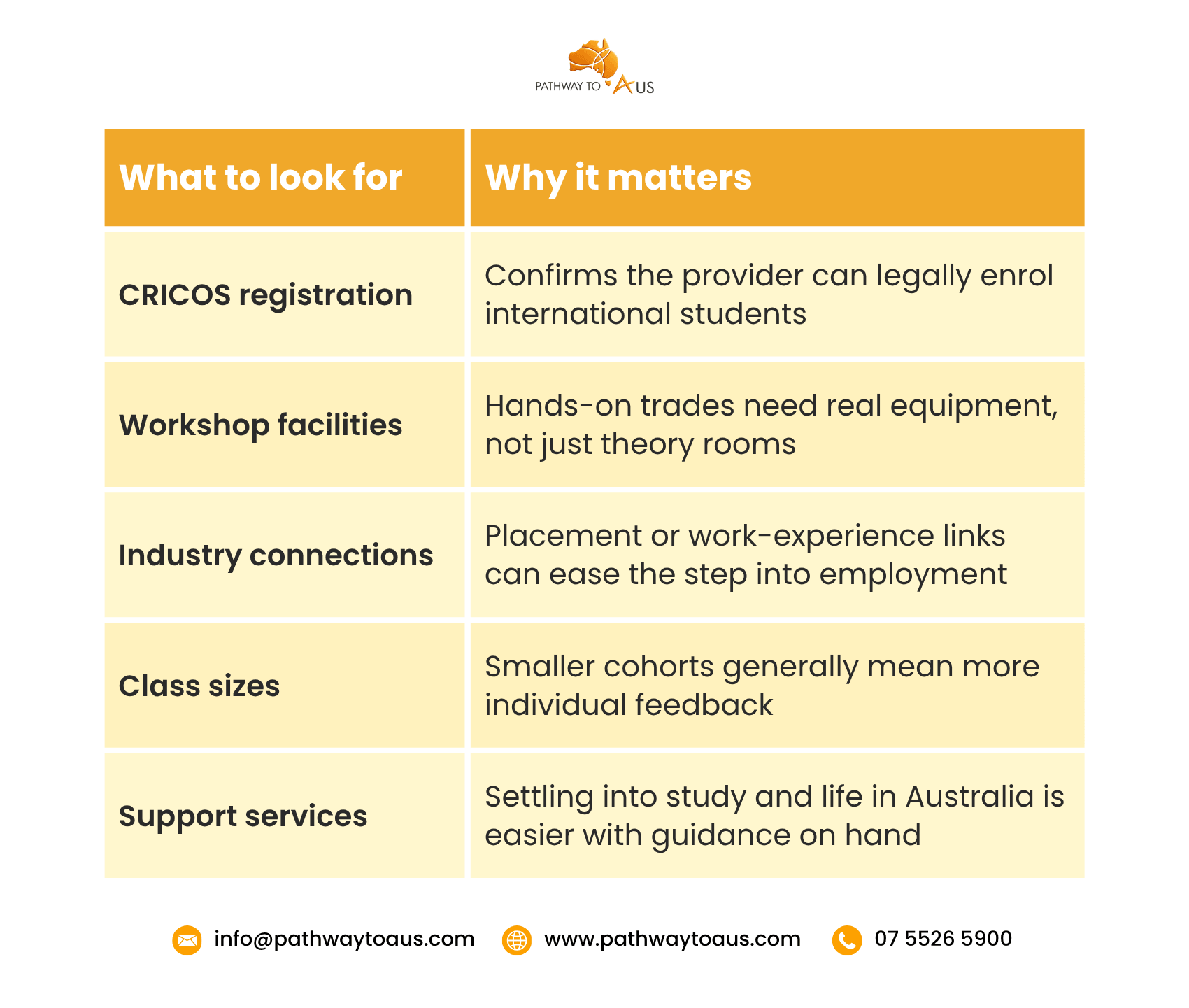
At Pathway to Aus, this is precisely where we tend to add the most value. We help you shortlist providers against criteria like these, rather than picking a course on marketing alone, so the qualification you end up with is one that genuinely reflects the skills you'll need in the workplace.
Thinking Beyond the Classroom: Visa and Career Pathways
Painting and decorating sits within a trade category that has, at various points, appeared on Australia's skilled occupation lists, which is one reason it draws interest from students thinking about their longer-term future here. That said, migration policy shifts regularly, and eligibility depends on a range of personal and legislative factors that can change.
We'd always encourage you to treat any course as a genuine investment in a trade you want to practise, rather than purely as a visa shortcut, and to get tailored, up-to-date advice before making assumptions about where a qualification might lead.
What we can say with more confidence is that a Certificate III in Painting and Decorating builds a practical skill set that's transferable, whether you eventually pursue further study, apprenticeship-style employment, or explore migration options down the track.
Our team at Pathway to Aus works alongside students at each of those stages, from course selection through to skills assessments and visa applications, so you're not trying to piece the pathway together alone.
Australia Life
Practical guidance on settling into everyday life as an international student.
Making the Most of Your Study Experience
A few habits tend to separate students who get the most out of this qualification from those who merely complete it.
- It is more important to attend every practical session than in most academic courses because it is very difficult to make up for lost workshop time.
- Asking enquiries in the time, as opposed to after a technique has gone awry, frequently saves both material and frustration.
- Additionally, it usually pays off to consider your classmates like coworkers rather than competitors because the profession you're entering heavily relies on teamwork and shared job sites.
It's also helpful to record your development. A future portfolio can be enhanced with pictures of your practical work, notes on tactics that worked for you, and a record of any workplace exposure you receive, regardless of whether you're seeking for a job, an apprenticeship, or a skills evaluation.
Sometimes people undervalue painting and decorating as a profession and write it off as easy brushwork. Anyone who has stood in a workshop attempting to match a colour exactly over a wide wall or create a perfect cut-in line knows otherwise. The training model in Australia is perfect for teaching the perseverance, expertise, and sincere care that this profession requires.
If you're considering this path, talking about your past, your specific objectives, and what a realistic schedule would look like is usually the best place to start. Our education agents at Pathway to Aus are prepared to have that discussion. We’d like to help you choose the best way the first time rather than you doing it on your own.
Frequently Asked Questions
How long does it take to study painting and decorating in Australia?
For overseas students enrolled full-time, a Certificate III in Painting and Decorating (CPC30620) typically takes 12 to 24 months; however, apprenticeship courses can take up to four years, depending on the provider and manner of study.
How much does it cost to study painting and decorating in Australia?
It's important to ask shortlisted providers directly for a comprehensive fee schedule that includes the cost of materials and equipment because course fees for international students vary greatly throughout registered training organisations.
Do you need a certain English level to study painting and decorating in Australia?
Although specific requirements vary per school and course, the majority of training providers want proof of English ability, frequently in the form of an IELTS score or its equivalent.
Can international students work while studying painting and decorating in Australia?
Under the terms of their particular visa, holders of student visas are usually allowed to work part-time in addition to their studies.
Is painting and decorating a good career choice in Australia?
Although individual career outcomes depend on geography, experience, and the overall job market, many students find it to be a satisfying trade due to the consistent demand for competent craftsmen and the comparatively short training process.