


Working as a Nurse & Earning Potential in Australia
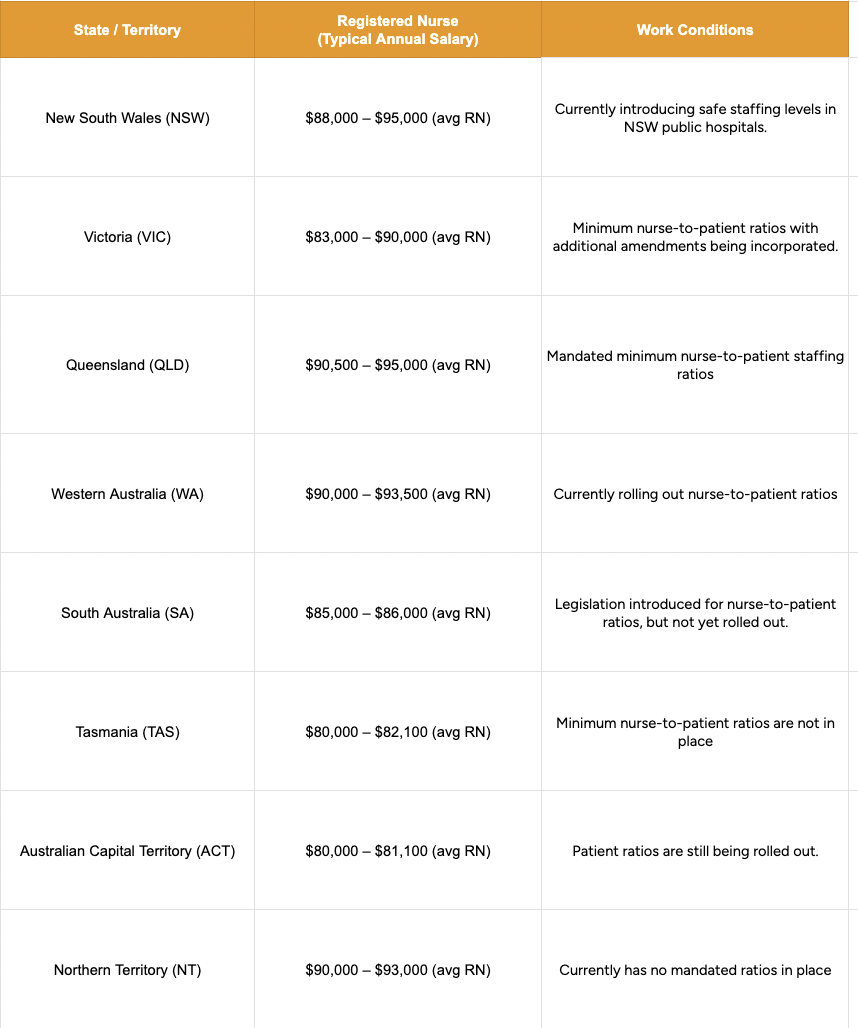
Source: Jobs and Skills Australia and Global Health Education Australia
👉 For an inside look on what it takes to work as a Nurse in Australia, learn more from our webpage.
Application ≠ Approval
This is a gentle reminder to note that a visa application doesn’t mean approval. If you follow the process and submit all the requirements, getting a visa grant is possible.
What do I need to know about the Nursing Pay Scale & Benefits in 2026?
Factors that influence earnings
1. Location
From a general perspective, Registered Nurses can make a weekly earning of $2,000 – $2,156 and an estimate of $84,000 – $112,000+ per year. The benefits of the occupation can often include health insurance, paid leaves, superannuation (retirement contribution), and professional development support. These may also vary depending on your experience and the place where you live and work.
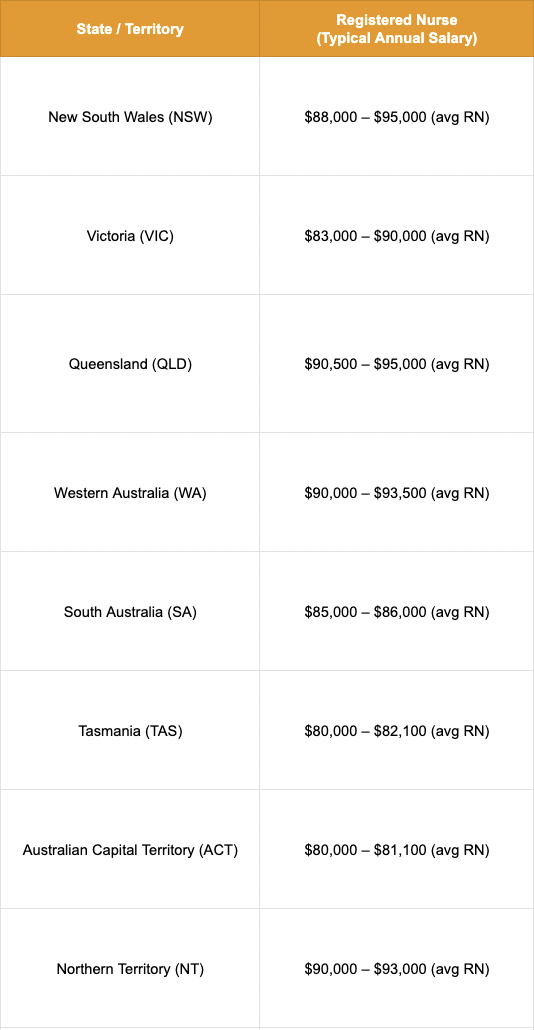
Source: Jobs and Skills Australia
From what’s been seen on job trends this year, there are 3 states/territories that can be the most beneficial to registered nurses, these are: Queensland, Northern Territory, and New South Wales (Source: Global Health Education Australia).
In Queensland, you may receive
- A $3,000 – $3,500 retention bonus after a year, $10,000 – $10,500 after 2 years, and $6,000 – $7,000 after three
- Free of subsidised accommodation
- Estimate benefits that go up to $3,500 for professional development allowance per year
In the Northern Territory
- Estimate combined allowances can go up to $40,000 for postgrad allowance, professional development, and shift responsibility allowances
- Rental and electricity allowances are provided for
- A salary package is offered estimating up to $27,500
In New South Wales
- You may get up to a $20,000 estimate salary bonus including additional incentives
- Accommodation and meals allowances are provided for
- Added leave benefits are given
Cities with high demand
For specific cities, these are the places that are in high demand for registered nurses — Sydney, Newcastle (NSW), Melbourne, Geelong (VIC), Brisbane, Gold Coast (QLD), Perth (WA), and Adelaide (SA). To get more details about salary expectations in different cities, we encourage you to do a deep dive of your own.
2. Experience & career level
A registered nurse’s salary goes up as their work experience increases.
In Australia, there are different kinds of nurses, and the range of salary depends on which pay grade you fall under. The levels are RN Grade 1: Newly registered (Years 1-3), RN Grade 2: Experienced (Years 3-4), RN Grade 3: Senior nurses (Years 5-8), and RN Grade 4-5: Management and advanced practice. As a Registered Nurse, there are certain job specifications which include: Clinical nurse specialist, Nurse unit manager, and Mental health nurse.
3. Education and qualifications
To work as a nurse in Australia, there are several key requirements you have to meet.
- Bachelor of Science in Nursing (BSN) or Diploma
- Credentials assessed by AHPRA (Australian Health Practitioner Regulation Agency)
- English Language Proficiency
- IELTS (Academic): minimum score usually 7.0 overall
- OET: grade B in all sections
English proficiency is critical for workplace safety and communication.
- Professional Registration
- The AHPRA registration is mandatory prior to working.
4. Specialisation
Sectors with occupations in high demand
Currently, there are particular spaces in the healthcare sector that have a shortage of registered nurses. The Aged Care, for example, where geriatric nursing is prioritised. The Mental Health sector, where there’s an increase for psychiatric nurses. The Critical Care & Emergency sector, where medical institutions are looking for skilled ICU and ER staff. The Regional & Rural Nursing spaces wherein Australia offers significant incentives to workers who are willing to be employed in regional hubs.
5. Public vs private sector
Public hospitals often offer higher compensation and benefits. On the other hand, private hospitals offer compensation depending on the employer.
Thinking of enrolling in a Nursing course or higher education? Start your journey here.
- Find a course or choose one of the Trade courses
- Fill out the PTA Enrolment Form
- Book a FREE Education Consultation
How do I Maximize my Earning Potential as a Registered Nurse?
There are many suggested ways on how to go about doing this, but here’s some of those that can perhaps give you the most advantage.
Additional Education
Pursuing Postgraduate degrees can significantly increase your salary by 15-30% (Source: CCMedical)
Specialise in high-demand fields
By focusing on specialisations, you’d fare better in sectors that are in shortage of highly skilled workers.
Aim for Leadership or advanced practice
Taking on supervisorial or managerial roles like Clinical Nurse Manager or Clinical Nurse Specialist can boost your chances of getting a higher pay.
Consider rural / remote roles
Rural and remote jobs offer different benefits and pay scales than the ones in the major cities and locations.
Negotiate your pay
Study and consider the package offered. You can do research on the current market rates from across different areas, qualifications, and work experience.
👉 Check out the Cheapest Nursing Courses in Australia in 2026 to see which would best work for you.
Working as a Nurse in Australia
Becoming a Registered Nurse as your occupation is a noble profession that provides the utmost care that patients need. In your pursuit of building income stability and achieving long-term goals, the best way you can make the most of your income is to be aware and knowledgeable about your work, skill set, and value.
If you want to discuss how you can work in Australia as a Registered Nurse, please feel free to get in touch with one of our lead migration agents.