


Jade’s Educate to Migrate Experience
Coming from the UK, Jade arrived in Australia through her Student Visa (500) to pursue her studies in Carpentry. She got her training at TAFE Queensland in Ashmore. Nick sat down with her to talk about her unique study-to-work carpentry pathway — what it was like to be a carpentry student, becoming a full-time carpenter, and successfully securing permanent Australian residency through her trade skills.
Application ≠ Approval
Carpentry from Her POV
Deconstructing the student experience
Jade shared details about schooling that hopefully provides more insight into studying a trade course at TAFE Queensland from an international student’s perspective.
School Days
When asked about how her scheduling worked, this is what she shared:
It began in your first semester where you do alternates, but normally it’s on Wednesday, Thursday, Friday, so it does depend on your enrolment. But you do that for your first term, and then your Wednesday becomes your vocational placement day.
Certificate III in Carpentry
First Semester (First Term)
School days: Wednesdays, Thursdays, Fridays*
Vocational Placement Day: Wednesday
*Note: The scheduled days depend on your enrolment
Theory + Practical Application
We wanted to get a sense of what kind of classes you’d most likely have in carpentry school, and she said:
You do a bit of everything, really. Every module that you’re covering in your carpentry study, you’re doing a practical, and so you’re doing those assessments. It could be things from roofing, wall framing, for the foundation works of carpentry. There’s a variance. We even do stair building, because again, it’s part of the modules for measurements and calculation. So, yeah, there’s a good variance there where you’re able to sort of find what’s your key element that you’d like to do in the future.
Certificate III in Carpentry
School: TAFE Queensland
Carpentry Module: Theory + Practical + Assessments
Lessons include: (with Core Units and Elective Units)
- Roofing
- Wall Framing
- Foundation Works of Carpentry
- Stair Building
Getting in the Trade
We wanted to know if there’s a possibility to work while studying the course, and she gave very helpful advice:
When you begin the course, get in the trade immediately, either that’s through your VPC, because even having the work as a labourer, you’ll get an experience of the ground. I say that all the time. I say, ‘Get a job, even if you’re carrying timber, digging holes, whatever, it’ll get you familiar with the industry’. I can’t recommend this enough to people.
What she highly recommends: Once you start your study, find work early on
Reason: Real-world industry experience
Possible Pathway: Through VPC (Vocational Placement)*
Sample Occupation: Labourer
*Note: The Vocational Placement (VPC) is a mandatory study unit that immerses students in real work environments to apply their practical skills and knowledge.
Women Representation in Carpentry
We were curious to know what her insights were on the percentage of women in carpentry, and this is her empowering take on it:
There is still that little bit of old school, but I find it’s just a bit of a challenge where I take it on to educate people that that barrier is breaking slowly but surely. We’re increasing the number of females, and we’re just trying to encourage that it doesn’t define your capability or your greatness just because you’re male or female.
In her class: only 4 girls out of 42 students
In Australia: only 3% to 3.7% are women carpenters

Visas and Viable Work Prospects
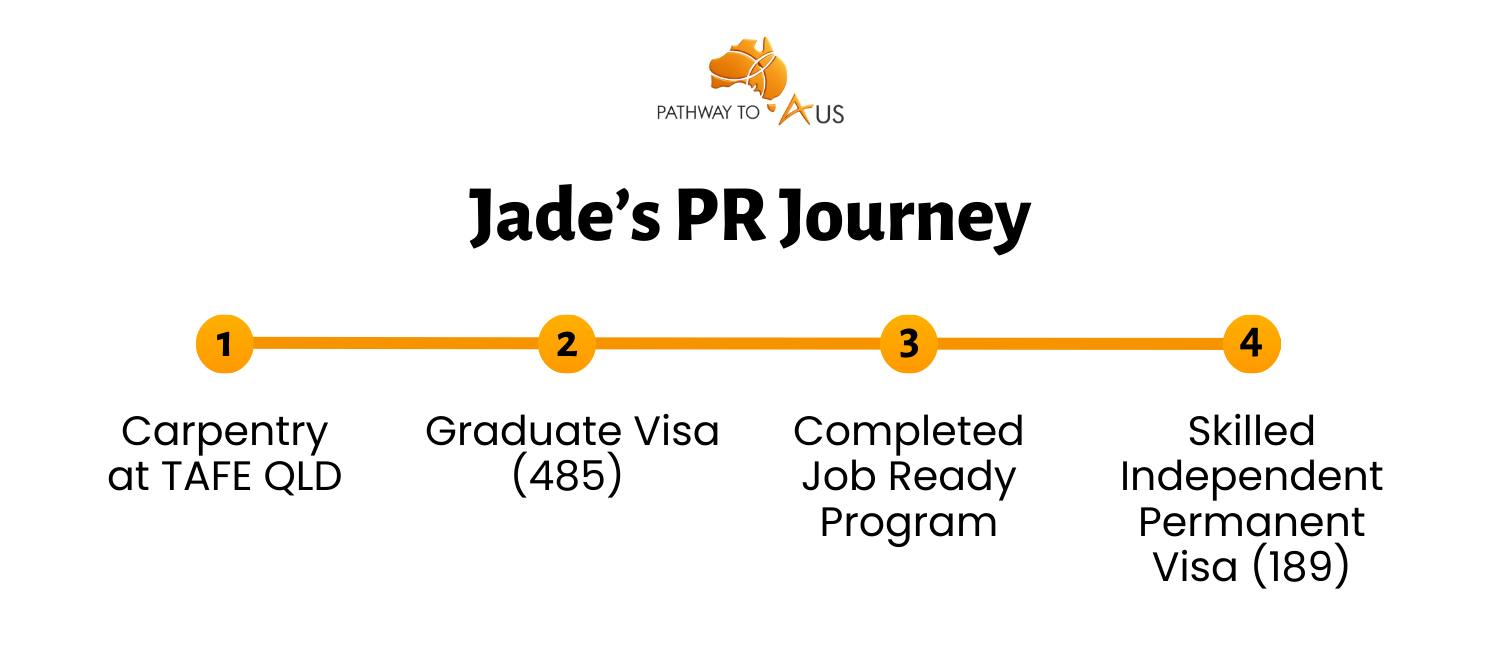
After Jade graduated from her carpentry course on her Student Visa (500), she was granted a Graduate Work Visa (485). With her skills assessment and work experience under her proverbial toolbelt, she then applied for a Skilled Independent Permanent Visa (189). She explains what the process was like for her.
Jade’s Visa Progression
1. Student Visa (500)
2. Graduate Work Visa (485)
3. Skilled Independent Permanent Visa (189)
Joining the Job Ready Program
With her Graduate Work Visa (485) secured, she entered the Job Ready Program where she got to work in the industry. Upon completion of her study for 12 months to demonstrate her skills and ability as a carpenter, she got a full skill assessment. She revealed to us how her experience differed from the usual JRP route:
So, at the time, when I finished, I got a job [then] working in the film industry. So, mine was a bit different; it changed. So, I went into the film industry when I was accumulating my Job Ready. I was pretty lucky because the film industry, [had] a minimum contract — it may depend on productions, but mine was 50 hours a week.
Skills Assessment + Skilled Independent Permanent Visa
You need a skill assessment if you want to apply for a permanent visa to Australia. Fortunately, Carpenters are right now probably one of the most in-demand occupations in Australia. The government’s really put a precedent on trying to get as many sorts of construction trades into Australia as possible, which is really good for General Skilled Migration and potential students.
Paving the Pathway to Aus experience
The next organic step for Jade to take was to get a Skilled Independent Permanent Visa (189). Pathway to Aus then stepped in to take her through the process and now, she’s got Permanent Residency. She shares with us how that happened for her:
You kept us informed with any changes with Immigration, which was very scary, especially being here in the COVID time of it. But yeah, you’ve given us the direction, shown us the visas, what the options are, the best avenue, and everything was arranged for us. We don’t have to do anything… Anything of the contents that’s required for that, you guys just ask us and we send it in. Simple as.
How Pathway to Aus has helped her
- Kept her informed with any changes in Immigration
- Gave her direction, showed her the process
- Offered her possible options and the best avenue
- Arranged the requirements and paperwork
From being a carpentry student to becoming a permanent resident, PTA was with her all throughout her journey. Asked if she would recommend Pathway to Aus, she had this to say:
100%. And we still talk about it now when we’re speaking with UK home, hence why we brought you a client the other week.
Visa Possibility
How studying Woodwork would work for you too
Here’s how you can craft your carpentry pathway:
1. Have a genuine interest in Carpentry and trade work
2. Apply for a Student Visa (500)
3. Come to Australia and study the course
4. Get a Graduate Work Visa (485) + work experience + skills assessment
5. Qualify to apply for a Skilled Independent Permanent Visa (189)
6. Have strong PR prospects and get a possible permanent visa grant