


The Non-Trade Study Pathway
The non-trade courses give the student applicant the opportunity to study a vocational or academic program in Australia through a Student Visa (500).
After completing the study program successfully, the student can apply for the Temporary Graduate Visa (485) which allows them to stay and work in Australia for a certain period of time. Then, they’ll have to get a positive result in their skills assessment through the TRA (Trades Recognition Australia). From there, they can go through the process of getting a work visa which ultimately can open the possibility of permanent residency (PR).
Application ≠ Approval
This is a gentle reminder to note that a visa application doesn’t mean approval. If you follow the process and submit all the requirements, getting a visa grant is possible.
Non-Trade Courses | What are they?
Service-oriented | Administrative | Specialised
Non-trade courses are vocational or academic school programs that aren’t technical or manual in nature. These can be found in fields such as education, health, business, and social services. They highlight honing skills that are more cognitive and interpersonal to prepare students for office, care or professional occupations.
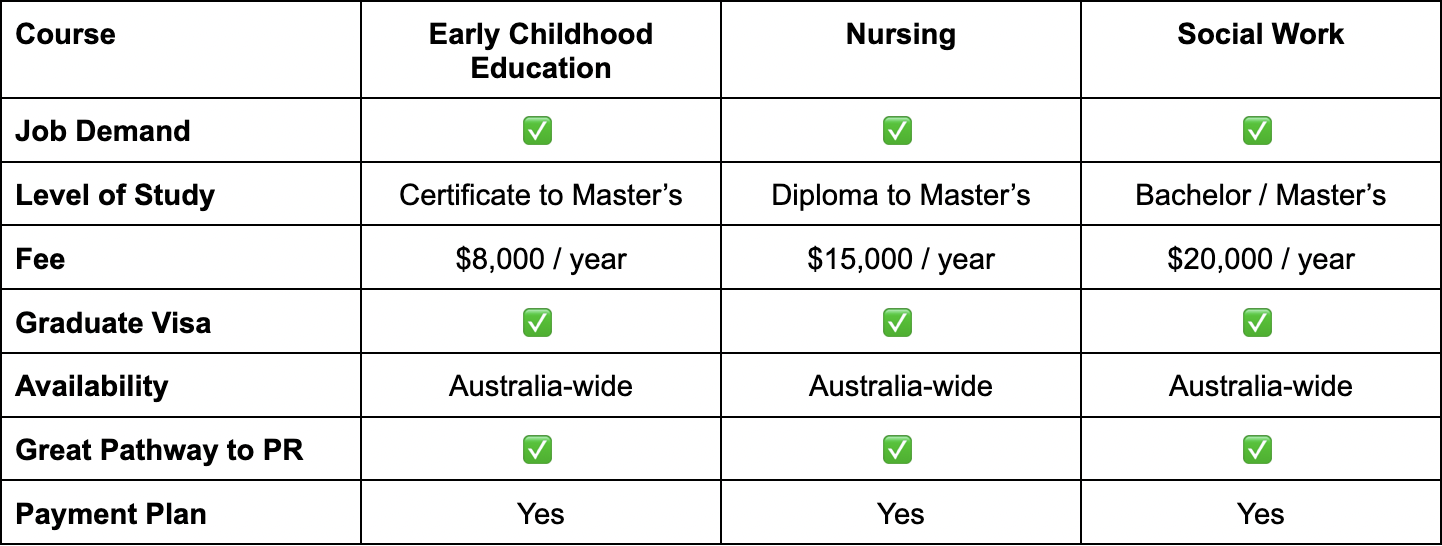
These are 3 non-trade courses that can open up possibilities for PR.
Early Childhood Education
The Bachelor of Early Childhood Education or teaching prepares students as specialists in the teaching of children from birth to 12 years. You can work as a teacher in Australian primary schools and kindergarten centres.
Essential things to know about studying Early Childhood Education
- Extremely high demand
- Certificate to master’s level
- $8000 tuition fee / year
- Eligible to apply for the Temporary Graduate Visa (485)
- Location: all over Australia
Potential Career Pathways
- Childcare centre or kindergarten director
- Education policy and program implementation
- Training and development roles in private and public organisations
- Education and outreach roles
- Developing products for the early childhood sector
- Learning designer
- Entertainment industry roles
- Consultancy
- Education research
Once you graduate and get your Graduate Visa (485), you can formally work and apply what you have learned to the education sector and gain more knowledge and experience along the way.
Nursing
Vocational institutions and universities in Australia produce some of the most highly-trained nurses in the world. With a focus on high-quality medical education and the use of the latest techniques and technology, Australian-trained nurses are in demand all over the world, and the employment opportunities are endless.
Essential things to know about studying Nursing
- Extremely high demand
- Diploma to a Master’s level
- $15000 tuition fee / year
- Eligible to apply for the Temporary Graduate Visa (485)
- Location: all over Australia
Potential Career Pathways
Diploma of Nursing:
- Provides students with the necessary knowledge and skills to work as an enrolled nurse (EN) under the supervision of a registered nurse (RN)
- Graduates can seek employment in various healthcare settings, such as hospitals, aged care facilities, community health centers, and clinics
- Enrolled nurses play a crucial role in providing direct patient care, administering medication, assisting with procedures, and monitoring patients’ well-being
- Have opportunities for career advancement and further education, such as bridging programs to become a registered nurse
Bachelor of Nursing:
- Prepares students to become registered nurses (RNs)
- Offers a broader and more in-depth understanding of nursing theory, research, and clinical practice compared to a diploma
- Can work as registered nurses in a wide range of healthcare settings, including hospitals, community health centers, clinics, research institutions, and public health organisations
- Have a higher level of autonomy and responsibility in providing patient care, coordinating and leading healthcare teams, and making critical decisions regarding patient treatment
- Also opens up opportunities for specialisation or advanced practice nursing, such as becoming a nurse practitioner, nurse educator, nurse researcher, or nurse manager
The course that best fits your career goals
A Diploma of Nursing can provide a quicker entry into the nursing profession as an enrolled nurse, a Bachelor of Nursing offers a more comprehensive education and broader career prospects as a registered nurse. The choice between the two depends on your career goals, personal circumstances, and desired level of responsibility in the nursing field.
Social Work
This program equips you with the knowledge, skills, values, and ethical foundations for social worker practice in contemporary social policy, human service, and medical contexts.
Essential things to know about studying Social Work
- Bachelor degree to a Master’s level
- $20000 tuition fee / year
- Eligible to apply for the Temporary Graduate Visa (485)
- Location: all over Australia
Potential Career Pathways
- Social work
- Aged care
- Health services
- Youth work
- Counselling
Graduates will be eligible for membership to the AASW and to practice as professional social workers. Membership to the AASW enables you to apply to become a mental health accredited practitioner, which attracts a Medicare rebate for private practitioners.
Studying Social Work: PTA Resources
Course Recap
Want to start your Migration journey through International Study?
- Find a course or choose one of the Trade course
- Fill out the PTA Enrolment Form
Education to Permanent Residency Pathway
Early Childhood Education offers strong employment possibilities in Australian states and territories that are facing teacher shortages. Nursing, an in-demand occupation, lets you care for patients with different health conditions in clinics or institutions. Social Work helps you support diverse communities and provide a nurturing environment for them.
With these non-trade courses in mind — in high demand, wide availability, and offering great PR prospects — you’ll find that a fulfilling career path is possible for you in Australia. Once you’ve chosen your study program, you can contact us and speak to one of our lead education agents to guide you through your journey.