

Last Updated: 16 October 2026
Planning to join a family member in Australia? The rules on bringing family differ by visa, and several have changed recently. This guide explains what a subsequent entrant is, which visas it relates to, and what to check before you plan.
Note
Visa rules change often, and some information below, especially for students, may no longer apply to you. Check the Department of Home Affairs website or speak with our education agents for free advice before making any plans.
Key Takeaways
- A subsequent entrant is a partner or dependent child who was not in the main applicant’s visa application and applies separately to join them.
- From 2 October 2026, family members cannot be added to a Student visa (subclass 500) after it is granted. Home Affairs states that no exemptions apply.
- Most Student visa applicants can no longer include family when they apply. Limited exemptions exist.
- The Government has announced similar restrictions for Temporary Graduate visas (subclass 485). Check Home Affairs for the latest details.
- Skilled and employer sponsored visas have their own family rules. Requirements depend on the visa and the rules at the time you apply.
- A visa application is not a guarantee of approval.
What is a Subsequent Entrant Visa?
A subsequent entrant is a spouse, de facto partner or dependent child of a visa holder. They were not included in the main applicant’s visa application. They apply for their own visa to join the main visa holder in Australia.
Whether this option exists depends on the main visa holder’s visa type and the rules in force at the time.
What does it mean for family members of students, skilled workers and regional visa holders?
If a visa is granted, the family member may be able to live in Australia with the main visa holder, subject to the visa conditions.
Subsequent Entrant Visas by Subclass
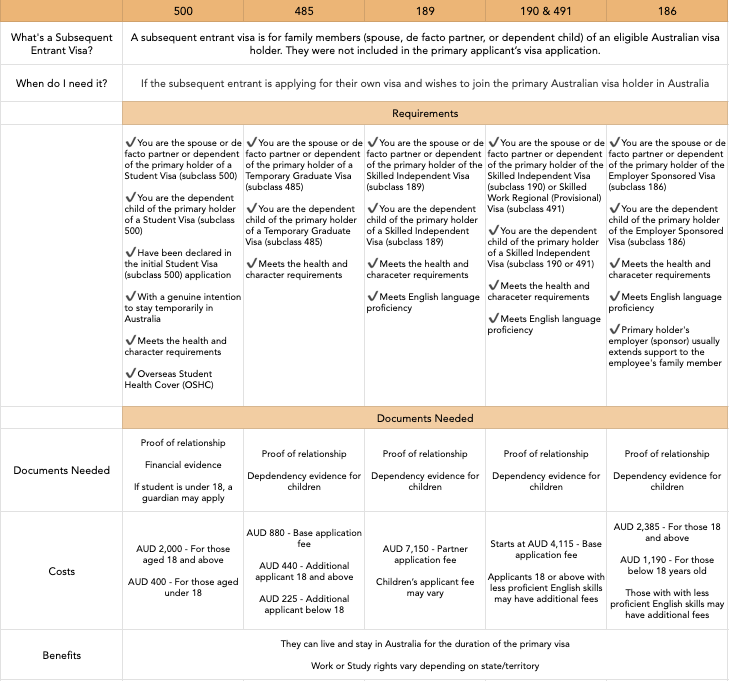
Below is an overview for the 500, 485, 190, 491 and 186 subclasses.
Application ≠ Approval
This is a gentle reminder to note that a visa application doesn’t mean approval. If you follow the process and submit all the requirements, getting a visa grant is possible.
Student Subsequent Entrant Visa (500)
Please note: Student visa rules have changed and may not apply to your situation. Check the Home Affairs Student visa changes page or contact our education agents for free advice.
Previously, family members could apply to join an international student after the student’s visa was granted. From 2 October 2026, this option is no longer available. Home Affairs states that Student visa holders can no longer add family members after grant, with no exemptions.
The rules for including family when applying have also changed. Most Student visa applicants can no longer include a partner or dependent children. Home Affairs lists exemptions for some groups, including:
- PhD students
- Students sponsored by the Department of Foreign Affairs and Trade (DFAT) or Defence
- Foreign government scholarship recipients
- Eligible students from Pacific or ASEAN member countries
Applications lodged before 2 October 2026 are assessed under the rules in place when they were lodged. Existing Student visas are not changed by the new rules.
Read more about the new Student Visa rules here.
Thinking of studying in Australia too? It can happen! Start here.
- Find a course or choose one of the Trade courses
- Fill out the PTA Enrolment Form
- Book a FREE Education Consultation
Graduate Subsequent Entrant Visa (485)
The Temporary Graduate visa (subclass 485) is for international students who have finished their studies. Family members of 485 holders have been able to apply as secondary applicants.
The Government has announced similar family restrictions for Temporary Graduate visas. At the time of writing, no start date or details were published. Families already in Australia on Student or Temporary Graduate visas as secondary applicants are not affected, according to the Minister’s statement.
Check the latest on the Home Affairs Temporary Graduate visa page before you plan.
Requirements usually include:
- Proof of relationship
- Meeting the health and character requirements
Read on: Post-graduate work
Skilled Nominated (190) and Skilled Work Regional (Provisional) Subsequent Entrant Visa (491)
The Skilled Nominated (subclass 190) and Skilled Work Regional (subclass 491) visas are for skilled workers nominated by a state or territory. Family members (spouse, de facto partner or dependent children) may be able to join the skilled worker in Australia, subject to the rules at the time.
Requirements usually include:
- Proof of relationship
- Meeting the health and character requirements
- English language proficiency
Deep dive into: What are EOI and ROI in State Nominations?
Want to understand your family’s options?
Book a Consultation with one of our registered migration agents.
Employer Sponsored Subsequent Visa (186)
Family members of a sponsored employee may be included in the Employer Sponsored Subsequent (subclass 186) visa application. Your employer or migration agent can confirm which supporting documents apply, such as a letter from the sponsor.
Requirements usually include:
- Proof of relationship
- Meeting the health and character requirements
- English language proficiency
Discover more about: Looking for Employer Sponsorships
An Overview of the Subsequent Entrant Visas
What about visa costs?
Visa charges change, usually each 1 July. Check the Home Affairs Visa Pricing Estimator for current charges before you budget.
Steps for a Subsequent Entrant Visa Application
1. Check the Current Rules
Confirm which rules now apply. The main visa holder’s visa type and your family relationship shape your options.
2. Being Included in the Primary Visa Holder’s Application
Where family inclusion is available, the primary visa holder includes you as a family member in their visa application.
For family members with an Employer Sponsored Visa (186)
Your sponsor or migration agent can advise whether a written letter from the employer is needed.
3. Gathering the Documents
Collect the documents that support your identity, character, health and, where required, English language proficiency.
4. Applying for the Visa
You apply through ImmiAccount, as the primary visa holder did.
5. Waiting for the Visa Outcome
Home Affairs receives and assesses the application.
If the visa is granted, you are told:
- Your visa grant number
- The date your visa starts
- Your visa conditions
If it is refused, you are told:
- The reasons for the refusal
- Whether you have a right to review the decision
The Subsequent Entrant Visa Process
Applying subsequently does come with its own complexities, but with the right help, you’ll be able to navigate the process better and more efficiently. That’s the kind of support we want to offer you. If you’re interested in applying for a subsequent entrant visa, book a consultation and have a conversation with one of our expert advisers — our migration agents who’ll gladly assist you through all of this.
Frequently Asked Questions
What is a subsequent entrant in Australian immigration?
A subsequent entrant is a partner or dependent child who was not included in the main applicant’s visa application. They apply separately to join the main visa holder in Australia. Whether this option exists depends on the main visa holder’s visa type and the rules in force at the time.
Can family members join a student visa holder after the visa is granted?
No. From 2 October 2026, Home Affairs states that Student visa holders can no longer add family members after their visa is granted, and that no exemptions apply.
Can international students include family in a Student visa application?
Generally no. Most applicants can no longer include a partner or dependent children. Home Affairs lists exemptions for some groups, including PhD students, DFAT or Defence-sponsored students, foreign government scholarship recipients, and eligible students from Pacific or ASEAN member countries. Check the Home Affairs Student visa changes page for the current list.
Do the October 2026 changes affect existing student visas or earlier applications?
Home Affairs states that applications lodged before 2 October 2026 are assessed under the rules in place when they were lodged. Current Student visa holders keep their existing visa.
Will family restrictions apply to the Temporary Graduate visa (subclass 485)?
The Government has announced similar restrictions for Temporary Graduate visas. At the time of writing, no start date or details were published. The Minister’s statement says families already in Australia as secondary applicants on Student or Temporary Graduate visas are not affected.
Where can I get advice on my family’s visa options?
Visa rules change often, so check the Department of Home Affairs website for current requirements. You can also speak with a registered migration agent. Pathway to Aus education agents offer free advice.