


When you start looking into employer sponsorship in Australia, it is easy to assume it is mostly for engineers, IT professionals or tradies. That is often the first impression. In reality, the picture is broader, and some less obvious occupations can also create strong sponsorship opportunities.
One of those occupations is Office Manager. The Jobs and Skills Australia estimates there are roughly 140,600 Office Managers in Australia, with an annual employment growth of around 3,000 jobs.
These numbers indicate just how ingrained and pervasive the role actually is and there’s a clear reason it’s gained interest, especially from folks looking for a practical function that may span a number of industries.
This employment might be a flexible route into employer sponsorship for the appropriate individual, and the right firm. It can also be part of a longer-term pathway to permanent residency in some cases.
At Pathway to Aus, we view sponsorship as something that calls for a well-thought-out plan rather than merely a hopeful application.
Our team comprises senior migration agents with extensive experience in employer-sponsored paths. We are a registered migration and education agency that has assisted over 1,000 clients from 50 different countries to study or relocate to Australia.
Having a job title on paper is never enough for sponsorship. A legitimate position, an employer who complies, and a visa route that works for you are all necessary.
Key Takeaways:
- In Australia, employer sponsorship is not just for engineers, IT specialists, or tradespeople; office managers are becoming more and more flexible in a variety of industries.
- The present eligibility framework may be satisfied by candidates with a diploma plus at least one year of relevant work experience; a bachelor's degree is not usually necessary.
- The 482 visa can be used as the initial step, and if the requirements are satisfied, a 482 to 186 transfer may occur via the Temporary Residence Transition stream or the Direct Entry stream.
- A legitimate position, a compliant employer, appropriate pay scales, and a well-planned approach from the outset are all necessary for a solid application.
Why Office Manager Jobs Are Getting Attention
The biggest reason this occupation stands out is flexibility.
An Office Manager is not tied to one narrow field. The role can exist in construction, retail, marketing, professional services and many other types of business. Unlike more specialised occupations, it sits close to the day-to-day running of a company, which means it can be relevant in far more workplaces than many people expect.
This patter is confirmed by Jobs and Skills Australia in the same report, which shares that Office Managers are most commonly employed across Professional, Scientific and Technical Services, Health Care and Social Assistance, and Construction. This reinforces just how much this role moves across industries rather than being confined to one.
That becomes particularly useful when you are researching how to get employer sponsorship in Australia. A broader occupation can sometimes give you a wider pool of potential sponsors. It is not automatic, of course. You still need the right experience, the right salary settings and a properly structured case. Even so, it is not a role you should dismiss too quickly.
What an Office Manager Actually Does
But what does an office manager do? Typically, an office manager is responsible for managing staff, allocating office resources, organising administrative systems, and maintaining internal records. Put simply, you are contributing to the seamless operation of the company in the background.
Your experience must match the actual responsibilities of the position. If your background is in office operations, admin coordination, internal systems or team support, that may be highly relevant. If the duties don't really align, then it's a much harder sell if the title is on your resume. In sponsorship matters, substance carries far more weight than labels.
Why Employers May Sponsor This Role
A business does not sponsor someone simply because they want to help them stay in Australia. Sponsorship only works if the function can be commercially funded.
Employers don’t need to be in one certain field to sponsor an Office Manager, but they need to prove the role is real and the remuneration is in accordance with the market rate. That is a significant part of the process.
Sponsorship is not about inventing a role for visa purposes. It is about showing that the business genuinely needs someone in that position, and that the role stands up commercially as well as legally.
Here is where many cases begin to unravel. Often people focus on the applicant side of the application and ignore the employer side, which also needs to be equally excellent.
At Pathway to Aus we help both applicants and employers to analyse that match early so that you are not constructing a strategy around a post which then becomes difficult to justify when the facts are scrutinised.
Basic Eligibility for the Applicant
One reason this option is so appealing is because it may not require a Bachelor’s degree.
An Office Manager is rated as ANZSCO Skill Level 2, often equivalent to an AQF Associate Degree, Advanced Diploma or Diploma. The Skills in Demand Core Skills stream requires a minimum of 1 year of relevant work experience in the nominated occupation or related occupation.
This can make a more realistic choice possible to those applicants with practical experience rather than university coursework. But at the same time you need to keep the points in proportion.
Lower entry requirements do not mean an easy visa. Your work history still needs to be relevant, your documents still need to support your claims, and the employer’s nomination still needs to fit the role properly. What it does mean is that, if you have real office management or administrative experience, this pathway may be more achievable than you first assumed.
Understanding the 482 Pathway
The temporary employer-sponsored stream is currently part of the Skills in Demand (subclass 482) framework, which replaced the old Temporary Skill Shortage (TSS) structure in December 2024.
This is one of the more practical sponsorship paths in Australia, not least since it can potentially open up a possible road to permanent residency later on.
In most cases, the process looks like this:
- The employer is or becomes an accredited Standard Business Sponsor
- The employer nominates the role
- You lodge the visa application
- The application is assessed by the Department of Home Affairs
There are also a few important details within that process. Labour Market Testing must generally show that the position was advertised for at least four weeks within the four months immediately prior to lodging the nomination application.
Salary is another key point. The Core Skills Pathway requires guaranteed annual earnings of at least $79,423 as of 1 July 2026, and the salary must also meet the market salary rate.
So while the pathway can be accessible, it still needs to be carefully structured on both the applicant side and the employer side.
482 to 186 Visa New Rules 2026: What People Are Really Asking
One basic question is typically at the heart of searches for terms like 482 to 186 visa new rules 2026 or 482 to 186 visa new rules: can temporary sponsorship still result in permanent residency?
While this is not a guaranteed or automatic pathway, the answer is that it can. But only if you meet the requirements of the permanent pathway available at that time. This is often where expectations need to be adjusted. A 482 visa can absolutely form part of the plan, but it is not the same thing as permanent residency.
It helps to think about the process in stages. The temporary visa may be the first step, while the 186 visa has its own criteria, thresholds and strategy.
Case Study: How Manisha Kept Her 186 PR Pathway on Track After Her Sponsoring Employer’s Business Collapsed
Manisha, an overseas-qualified accountant, found her Subclass 186 Employer Nomination Scheme application at risk after her sponsoring employer’s business collapsed mid-process. With her career and future in Australia hanging in the balance, our senior migration agent, Dr. Vrinda Biswas, guided her through withdrawing the compromised application and rebuilding her strategy with a new sponsoring employer. Her fresh 186 visa was granted within just a few months, showing what is possible when the right advice, timing and expertise come together.
The Pathway from 482 to 186 Visa Australia
The Temporary Residence Transition (TRT) stream is the most popular route from 482 to 186 visa Australia.
In order to be eligible for the 186 Temporary Residence Transition stream, candidates often need to have a subclass 457, 482, or suitable bridging visa and have worked in eligible sponsored employment for two of the three years before to applying. This is one of the main 482 to 186 visa requirements for applicants using the transitional route.
Another option is the 186 Direct Entry stream, which generally requires at least 3 years of relevant work experience and a positive skills assessment, unless an exemption applies.
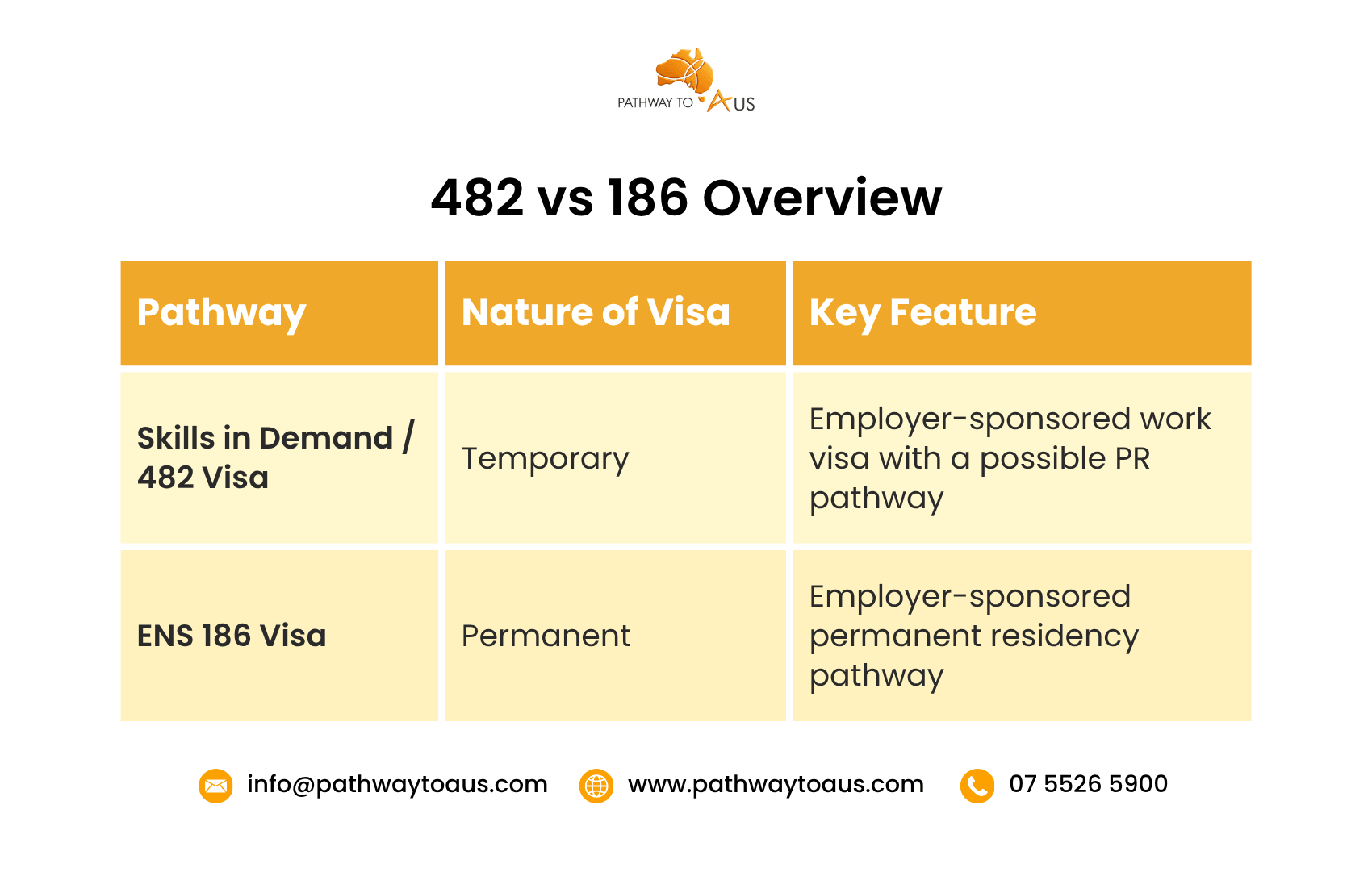
The real choice here is rarely about which visa sounds better. It is usually about where you are in your career, your experience level and what your employer can support. If you already meet the higher threshold, Direct Entry may be worth assessing. If not, the 482 can help you in developing the employer relationship and work history that could eventually be used to support an 186 application.
How Pathway to Aus Can Help
At Pathway to Aus, we do more than explain visa categories. We help you work out what actually makes sense for your situation.
Our certified immigration agents can assist you in determining your eligibility, selecting the best route, preparing the necessary paperwork, and comprehending the steps that both you and the employer must take at each level.
Your goals and background evaluation, a recommendation for a visa type, an eligibility check, a detailed process overview, a breakdown of costs and timelines, and a customised migration strategy are all included when you schedule a consultation.
As an applicant, we can assist you in determining whether the 482 or 186 path merits more consideration and whether Office Manager is a practical fit.
We can provide you with a more structured and clear understanding of the sponsorship procedure if you are an employer. That support can help you proceed with a much stronger plan, but it does not guarantee a visa outcome—and we would never promote it that way.
Book a consultation with one of our migration experts today.
Frequently Asked Questions
Can I apply for a 186 visa while on 482?
If you fit the requirements for either the Direct Entry stream or the Temporary Residence Transition stream, you can apply for the Subclass 186 visa while possessing a 482 visa. The position must meet the requirements of the current framework, and your company must still nominate you.
How long does it take to get a 482 to 186 visa?
The Department of Home Affairs determines the processing times, which vary according on the stream, occupation, and thoroughness of the application. Compared to incomplete applications, well-prepared 186 applications with comprehensive supporting documentation typically proceed more smoothly.
How do I get an employer-sponsored visa for Australia?
You must have an eligible Australian employer willing to nominate you for a legitimate position that is listed in an occupation list such as the Core Skills Occupation List and you must meet the skills, experience and salary requirements. The employer must also be, or become, a recognised Standard Business Sponsor.
What are the requirements for an employer-sponsored visa?
The general elements required are: a genuine nominated position; an appropriate sponsoring employer; a wage at or above the market rate and any relevant threshold; and applicant experience that corresponds to the occupation. Also prerequisites of health, character and English.
How long does an employer-sponsored visa take?
Timeframes depend on the visa subclass, stream and quality of application. Official processing times are announced by the Department of Home Affairs. Complete applications with all the supporting evidence are usually processed faster and with less delays.
How much does it cost for an employer to sponsor a visa?
Costs normally consist of the sponsorship application fee, nomination fee, Skilling Australians Fund levy and the visa application payment. Total expenses vary depending on the size of your firm, the visa subclass, and family members participating in the application.
Can I get PR in Australia with a 482 visa?
The 482 visa is temporary, yet it can be a gateway to permanent residency under the Subclass 186 visa if you fit the conditions at the time. Progression, however, is not automatic and is dependent upon your work history, employer support and eligibility settings.