


Skilled visa refusal reasons in Australia tend to follow a pattern, and it's rarely the dramatic disqualifications applicants fear most. At Pathway to Aus, our migration agent team regularly reviews expression of interest and application files, and the same two issues surface again and again: credentials that quietly expire before an invitation arrives, and points claimed on skill select that don't quite match what the skills assessment outcome letter actually says; neither is extraordinary. Both are entirely preventable, provided you know where to look before you submit.
This guide covers the common reasons for refusal of a skilled worker visa, how you might go about appealing if that does happen and what steps generally follow a refusal notice. None of it replaces a consultation with someone who can look at your specific circumstances, but it should help you understand the landscape before you speak with someone who can look at your specific circumstances.
Key Takeaways
- The reasons for refusal of skilled visas in Australia are often procedural. One of the most common reasons for a visa refusal is an expired skills assessment or English test result prior to the issuance of an invitation.
- Overclaiming work experience points on skill select, particularly when it doesn't match the qualifying experience figure on the skills assessment outcome letter, is another frequent and avoidable cause.
- Review rights after a refusal depend on the visa subclass and refusal ground, and any deadline to lodge with the Administrative Review Tribunal is typically short and strictly enforced.
- It is always best to read the refusal notice carefully, collect all relevant documents and seek an independent assessment early on to strengthen your position for the next step, whether that is an appeal or a fresh application.
What Are Common Reasons for Australia Skilled Visa Refusal?
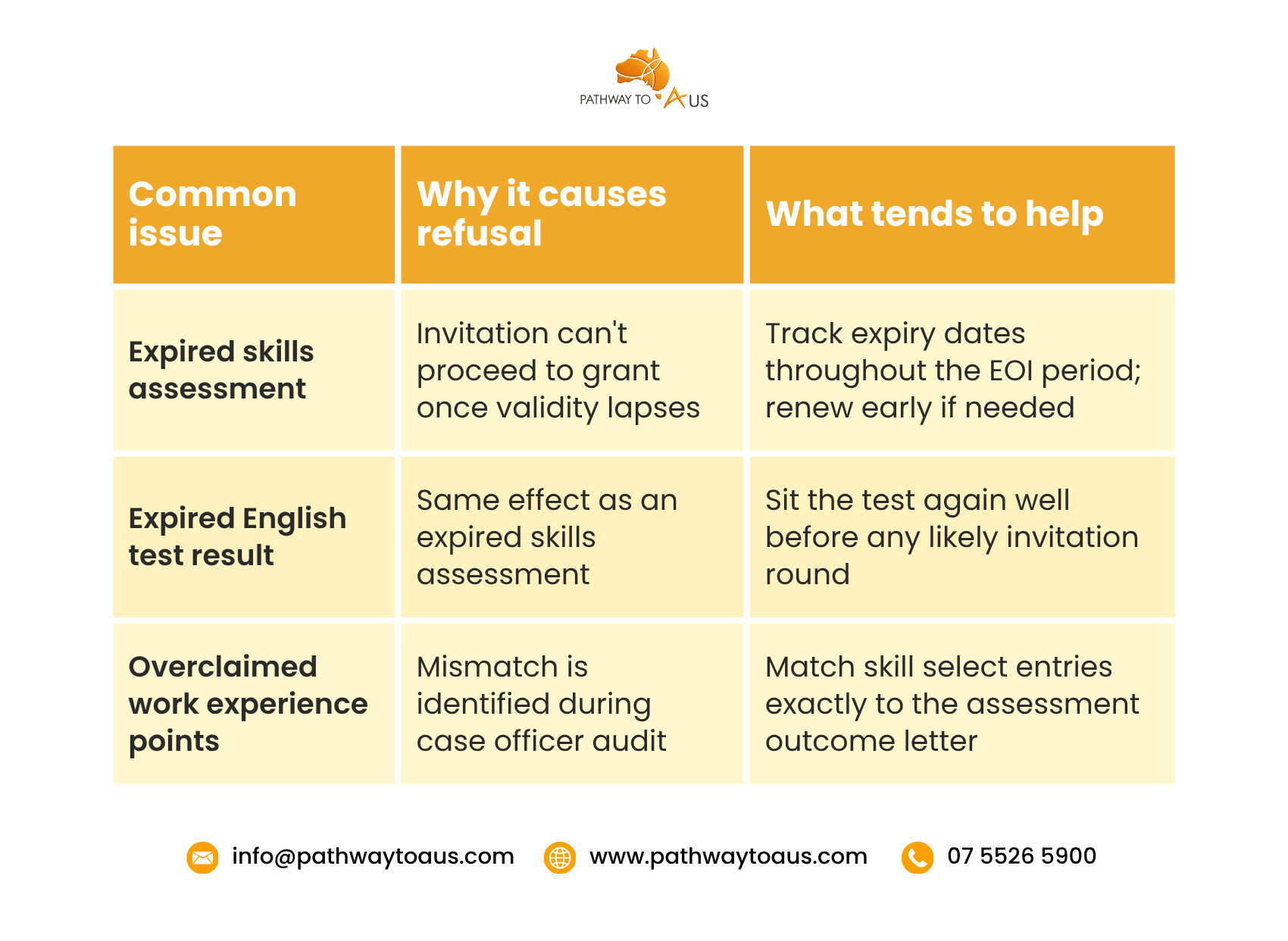
1. Expired Credentials at the Wrong Moment
The first major reason for an Australian visa refusal is timing, not eligibility. Your skills assessment and your English language test result both carry an expiry date. If your skills assessment or English evidence no longer meets the applicable validity requirements when that is required, it can affect your eligibility and may put a risk to your skilled visa application.
This catches people out because the expression of interest stage can sit open for months, sometimes longer, while you wait for an invitation. It's genuinely your responsibility to track validity throughout that waiting period, not just at the point you first submit your EOI. If a credential is due to expire before an invitation seems likely, it's usually worth arranging to redo the assessment or the test well ahead of time, rather than waiting to see what happens.
A simple habit helps here: note both expiry dates somewhere you'll actually check, and revisit them every few months while your EOI is live. It sounds basic, and that's exactly why it gets missed.
2. Overclaiming Points on Skill Select
The second, and arguably less understood, cause of skilled worker visa refusal is overclaiming points, particularly around work experience. When you enter your employment history into skill select, the system calculates your points automatically based on the dates and details you provide. That calculation is only as accurate as your inputs.
Here's where it goes wrong: Many skills assessment bodies deduct a portion of your claimed work experience, treating it as what they term qualifying experience rather than counting it in full. If your outcome letter states that two years have been deducted, your skill select entry needs to reflect that same reduction. Entering your full, undeducted work history instead of the assessed figure is a common and costly mistake.
This discrepancy is precisely the sort of thing a Department of Home Affairs case officer checks closely during an audit, particularly once an invitation has been issued and the application moves to the decision stage. If the points claimed don't align with the assessment outcome letter, it's likely to be flagged, and it can lead directly to refusal, even for applicants who made the error unintentionally rather than through any attempt to mislead.
The safeguard is straightforward in principle: read your outcome letter closely, line by line, and mirror its figures exactly when you complete your skill select entry. If there’s anything unclear about the letter, it’s worth asking the assessing body or a migration professional before you submit, not after.
Student Visa Refusal Overturned: Johnrick's Success
Another genuine client outcome, showing what a successful review can look like in practice.
How Can I Appeal an Australia Skilled Visa Refusal?
If a refusal has already happened, review rights are very dependent on the visa subclass and the specific reason for refusal, so this is really a 'check your own letter' situation rather than one single process for all. That said, there are some general principles worth understanding.
Merits review for most skilled visa refusals is handled by the Administrative Review Tribunal, which replaced the former Administrative Appeals Tribunal. The refusal letter you receive from the Department of Home Affairs should state whether you have review rights, and if so, the strict deadline by which an application to the tribunal must be lodged.
These deadlines are typically short and are not usually extended, so acting quickly matters more than almost anything else at this stage.
An appeal to the tribunal isn't a chance to submit a materially different application. It's a review of the decision based on the information available, sometimes alongside additional evidence you're permitted to provide. That's why the quality of your original submission is so crucial, and why appeals are more successful when the root problem is a genuine mistake, like a documentation gap, rather than a fundamental eligibility failure.
This is an area where getting professional guidance early tends to matter more than in most other parts of the migration process, considering that tribunal processes and evidentiary requirements change periodically and your eligibility for review depends on your particular visa subclass and refusal ground.
Our migration agent team at Pathway to Aus regularly helps applicants assess whether a review is realistic, and if so, how to strengthen the case within the tribunal's constraints.
How to Lodge an Appeal
A practical walkthrough of the lodgement process once you've decided to pursue a review.
Steps to Take After Receiving an Australia Skilled Visa Refusal Notice
A refusal notice can feel like the end of the road, but the next few weeks are often where the outcome is really decided, so it’s worth tackling them methodically rather than reactively.
Read the letter in its entirety, more than once. Refusal notices usually include the specific ground for refusal and any review rights and the deadline for exercising them. It's easy to skim this under stress and miss a detail that changes your options considerably.
From that point, a few steps tend to apply broadly, though the specifics will depend on your own situation:
- Confirm your review rights and deadline immediately. If a tribunal review is available, the clock is likely already running, so this isn't something to leave for later in the week.
- Gather every document connected to the decision. Your original application, the skills assessment outcome letter, correspondence with the Department, and the refusal notice itself all matter for understanding what went wrong.
- Get an independent read on the refusal reason. When you are the one who has filed your own case, it is really hard to be impartial about your own file. A new and experienced pair of eyes is more likely to see what caused the rejection, and whether it can be fixed, than if you review it by yourself.
- Consider whether a new application may be better than an appeal. Depending on your circumstances and the visa options available to you at the time, it may be that the most realistic way forward is to prepare a new corrected application. This is particularly the case where the ground of refusal is unlikely to be overturned on review.
- Until you have a plan, don’t send anything else. Sending additional documents or contacting the Department reactively, without understanding how they fit into either an appeal or a new application, can occasionally complicate matters rather than help them.
None of this assures any particular outcome. To say otherwise would be misleading as migration decisions are made on individual circumstances, policy settings that change over time and the specific facts of each case. The clear-eyed read of the refusal reason and timely, well-informed action is what really puts you in a better position.
Getting the Right Support
Skilled visa refusal reasons in Australia are frequently procedural rather than fundamental, expired credentials, or a points mismatch traced back to an assessment outcome letter, rather than a lack of genuine eligibility. That distinction matters, because it means many refusals are avoidable with careful preparation, and some are genuinely worth appealing once they've occurred.
If you're preparing an expression of interest, reviewing a refusal notice, or simply want a second set of eyes before you submit, our professional team at Pathway to Aus is set up to help. Our migration agents work with skilled visa applicants at every stage, from checking credential validity before an EOI goes live, to reviewing skill select entries against assessment outcome letters, to advising on review options after a refusal.
The easiest way to avoid becoming one of these figures is to get in touch early, ideally before you lodge rather than after a refusal notice arrives.
Frequently Asked Questions
How long does an Australian visa refusal review take?
The length of time for the Administrative Review Tribunal's review varies considerably depending on the visa subclass and tribunal caseload and can range from several months to well over a year in more complex matters.
How much does it cost to appeal a visa refusal in Australia?
When lodging a review you are required to pay the Administrative Review Tribunal an application fee which is determined by the tribunal. If your application is successful you may be able to get part of this fee refunded. The cost of professional representation is separate and varies between providers.
Can I reapply for a skilled visa after a refusal instead of appealing?
In many cases a new application is possible, provided the underlying eligibility problem has been fixed. Whether this is preferable to an appeal depends on the refusal ground and visa subclass.
Does a visa refusal affect future Australian visa applications?
A refusal does not necessarily mean you cannot apply again in the future, but it may have to be disclosed on future applications and may lead to greater scrutiny depending on the circumstances.
What is the difference between a visa refusal and a visa cancellation in Australia?
A refusal is a case where a visa is not granted because the application doesn’t meet the requirements. A cancellation is a case where a visa is granted and then subsequently withdrawn. They have different review pathways.