


If you're weighing up your options for permanent residency and university just doesn't feel like your fit, you're in good company.
Every week, we speak with international students who assume a degree is the only route in. And every week, we walk them through why trade courses in Australia for PR are one of the most practical, affordable, and time-efficient pathways available today.
The construction industry is stretched, the Skilled Occupation List continues to favour hands-on trades, and the qualification you earn as an international student is the same one an Australian apprentice earns after four years on the tools.
For more than a decade, our team has guided international students through this exact journey (from the first course enrolment right through to the final visa grant) and the pattern is remarkably consistent. When the pathway is planned properly from the start, the trade route works.
Key Takeaways:
- Trade courses in Australia for PR can offer a shorter and often more affordable route than university, but they do not carry the same points weight as a bachelor degree on the skilled migration points test.
- Your course must lead to an occupation on the Skilled Occupation List and the ANZSCO code must relate to the work you will do after you graduate.
- You’ll need to hold a valid post-study visa (485, 407, 417/462 or 482) for the twelve months of skilled employment required for your skills assessment.
- The four stage Job Ready Program with Trades Recognition Australia is what you need to complete to be eligible to receive your skills assessment letter.
- Having a full skills assessment allows you to submit an EOI via SkillSelect and nominate for the 189, 190 and 491 visa in one application to increase your chances of being invited.
Why More Students Are Choosing A Trade Over A Degree
Looking at the numbers, the shift is easy to understand. A trade course is about two years, a bachelor’s degree is typically three or four. Tuition for trades sits well below university fees, and yet the qualification carries equal weight when it comes to the points test for skilled migration.
That combination (shorter timeline, lower fees, same points) is why interest in studying a trade in Australia has climbed so sharply in recent intakes.
Building trades in particular sit near the top of Australia's skilled shortage lists. Carpentry, joinery, bricklaying, plastering, and wall and floor tiling all remain in strong demand, and invitation rounds in recent years have shown these occupations moving through the queue at some of the lowest points thresholds in the skilled program.
Step 1: Choose A Trade Course That Aligns With The Skilled Occupation List
The first decision matters more than most. Your course needs to lead to an occupation that appears on Australia's Skilled Occupation List, and its ANZSCO code has to match the work you'll eventually be doing.
Get this wrong at enrolment, and you can spend years down a road that doesn't end in PR.
The trades our clients most often choose include:
- Carpenter (ANZSCO 331212)
- Carpenter and Joiner (ANZSCO 331211)
- Bricklayer
- Plasterer
- Wall and Floor Tiler
- Joiner
Every course you consider should be CRICOS-registered, which is a requirement for holding a student visa, and it should include the practical placement hours your future skills assessment will rely on.
If you'd like a shortlist of programs that map cleanly to a PR outcome, our team has put together a guide to the top-tier trade courses in Australia — a good starting point before you speak with an agent.
Studying A Trade In Australia — Full Course Guide
A comprehensive breakdown of fees, work rights, and PR pathways for every major trade currently offered to international students.
Step 2: Understand The 12-Month Post-Study Work Requirement
Here's where many hopeful applicants get caught out: Finishing your course is only half the story.
To satisfy the skill assessment that underpins your PR application, you'll need at least twelve months of paid, skilled employment in your trade after graduation — not casual work, and not something unrelated. The work has to reflect the occupation you're claiming.
That means your visa strategy needs to be locked in long before you throw your graduation cap in the air.
Step 3: Pick The Right Visa To Cover Your Work Year
You'll need to hold a valid visa for the full twelve months of post-study employment, and the right choice depends on your age, nationality, and circumstances.
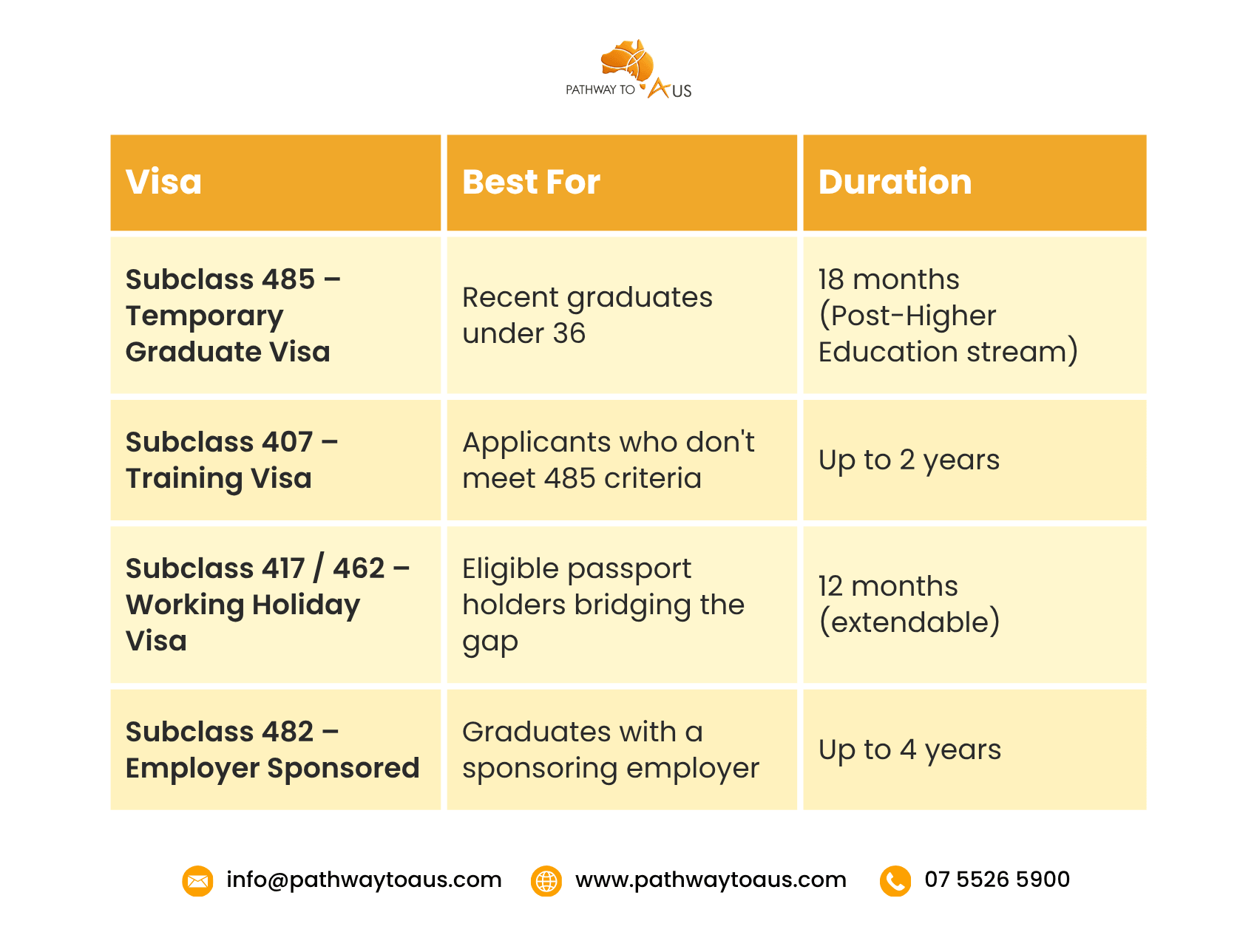
If the 485 isn't available to you for age or timing reasons, don't panic — we've written about the other options that can keep your pathway moving. The point is to choose the visa that gives you enough runway to complete both your employment and your skills assessment, so you're never scrambling as the clock runs down.
Step 4: Complete The Job Ready Program
The Job Ready Program, run by Trades Recognition Australia (TRA), is the four-step employment-based skills assessment every international trade graduate must complete. Think of it as the tradie equivalent of the assessments other professions go through — practical, structured, and non-negotiable.
The program has four stages:
- Provisional Skills Assessment (PSA): lodged before or shortly after graduation
- Job Ready Employment: begin your twelve months of paid work in your nominated trade
- Job Ready Workplace Assessment: an on-site review, typically around the halfway mark
- Job Ready Final Assessment: issues your full skills assessment letter once everything checks out
Along the way you'll be uploading payslips, employment contracts, duty statements, and reference letters. Miss a payslip or a milestone and the timeline can stretch; which is exactly why our clients lean on our Job Ready Program service to stay on track.
Job Ready Program 2025 — The Complete Walkthrough
Our 2025 guide to the Job Ready Program walks through the current requirements in more detail.
Step 5: Submit Your Expression Of Interest
When you have received your full skills assessment the next step is to lodge an Expression of Interest through SkillSelect. In your EOI you can nominate up to three visa subclasses at once (the 189, the 190 and the 491) giving you the widest possible field of chances to be invited.
- Subclass 189: Permanent independent skilled visa, no sponsor needed
- Subclass 190: Skilled Nominated visa (state or territory nominated)
- Subclass 491: 5-year provisional regional visa with a pathway to permanent residency through the 191
EOIs Explained: Your First Step To 189, 190 & 491 Visas
If EOIs feel like a black box, our explainer on how they work is worth a read before you lodge.
How Points Work And Why Trades Are Currently Competitive
The minimum score that will be considered is 65 points and the points test rewards a familiar mix of age, English, qualifications, work experience and nomination. State nomination adds five points to a 190 and regional nomination raises a 491 by fifteen; which can be the difference between waiting quietly in the queue and getting an invitation.
In recent rounds, several trade occupations have been receiving invitations at or very near that 65-point floor. That's a meaningful signal, but it's not a promise; the program balance shifts, points thresholds move, and no one (us included) can guarantee any particular outcome.
What we can say is that when you plan the whole pathway from day one, you give yourself the best possible chance of landing on the right side of an invitation round.
Common Pitfalls We See And How To Avoid Them
Over the years, the same handful of mistakes come up again and again:
- Enrolling in a course that isn't on the current Skilled Occupation List
- Treating the Job Ready Program as optional or a formality
- Letting the ANZSCO code drift away from the actual job duties on your payslips
- Allowing a visa to lapse before an EOI is lodged
- Overlooking regional nomination when city-based competition is fierce
Each one is fixable early. None are easily undone late.
Ready To Map Out Your Own Pathway?
There's a reason we called our whole approach Educate to Migrate. The trade route is one of the most reliable ways into Australian permanent residency, where the course, the work, the visa and the assessment are stitched together from the very first conversation.
Book an initial consultation with our team and we’ll walk you through your specific options: no shortcuts, no promises we can’t keep, just a straight read on what your best pathway looks like.
Frequently Asked Questions
Which trade course is easiest to get PR in Australia?
Among the most readily accessible trades are carpentry, bricklaying, plastering, wall and floor tiling and joinery, which regularly appear on the Skilled Occupation List and receive invitations at some of the lowest points thresholds. Difficulty is not the only factor, your budget, physical suitability and long term career interest will determine the right fit for you.
How much do trade courses in Australia cost for international students?
The government charges alone start at AUD 6,140 for the primary 186 applicant (from 1 July 2026) and include an additional nomination application fee of AUD 540 and a one-off Skilling Australians Fund (SAF) levy of AUD 3,000 or AUD 5,000 paid by the employer depending on the business size. In total costs typically increase further once you factor in the costs of including family members, English testing and professional migration advice.
Can I study a trade course in Australia without IELTS?
Proof of English proficiency is usually required by trade colleges. IELTS 5.5 to 6.0 is the standard, but PTE, TOEFL and Cambridge results are very widely accepted. If you have done prior study in English, or come from a recognised English-speaking country, some providers will waive formal testing.
How much do qualified tradies earn in Australia?
A qualified tradie in Australia earns an average full-time salary of around AUD $89,000 to $96,000 per year, with self-employed and specialist trades often clearing well above six figures. Wages generally rise quickly with experience, licensing, and location, particularly in regional and mining areas.
Is a trade course or a degree better for PR in Australia?
Both pathways can lead to permanent residency, but trade courses are usually faster, cheaper, and closely aligned with occupations currently in shortage on the Skilled Occupation List. A degree may suit you better if your career goals sit in a professional field, while trades tend to offer a more direct migration outcome for hands-on work.