


If an Australian employer has offered to sponsor you, the next decision often comes down to the 482 vs 186 visa question, and it is rarely as simple as it first appears. The instinct is to reach straight for permanent residency, since the Subclass 186 is the visa most people picture when they think of settling in Australia for good.
Yet the closer you look at the requirements, the clearer it becomes that the "obvious" choice is not always the workable one, and the pathway that suits your circumstances today may look quite different from the one that gets you to PR in the long run.
If you are somewhere between "which visa" and "when do I lodge", you are in familiar territory. We talk to sponsored workers and Australian businesses about this dilemma every week here at Pathway to Aus, and the same theme keeps coming up: the option that looks simple on the surface is not usually the one that fits your circumstances underneath.
This article will walk you through the distinctions that actually matter so you can go forward with a clearer picture of what suits you best.
Key Takeaways:
- The 482 vs 186 visa decision is not simply "temporary versus permanent", it depends on your work history, age, English, and your employer's readiness to sponsor.
- The 186 Direct Entry stream demands a positive skills assessment, three years of highly relevant experience, an under-45 age at application, and Competent English.
- The Subclass 482 typically needs only one year of highly relevant experience, usually no skills assessment, and carries a lower English threshold with no age cap of its own.
- Under the 482 to 186 TRT pathway you can transition to permanent residency after two years with the same nominated occupation with your sponsoring company, however age requirements and case specific circumstances still apply.
- Before you commit, it is worth getting professional counsel as choosing the wrong stream might cost you time, money and momentum towards permanent residence.
What Each Visa Actually Offers
The Subclass 482 visa, now known as the Skills in Demand (SID) visa, is a temporary employer sponsored visa that lets you live and work in Australia for up to four years with an approved sponsor. It is often the first step for skilled workers who have found an Australian employer but do not yet meet every requirement for permanent residency.
The Subclass 186 visa, formally known as the Employer Nomination Scheme, is a permanent employer sponsored visa. Approval means you become an Australian permanent resident from day one, with access to Medicare and the ability to include eligible family members. It has two streams that matter here: the Direct Entry stream and the Temporary Residence Transition (TRT) stream.
But there’s the distinction between temporary and permanent, and it impacts everything that follows, from your family’s movement to your path to citizenship. Which is why the decision demands more than a cursory comparison.
The Core Differences at a Glance
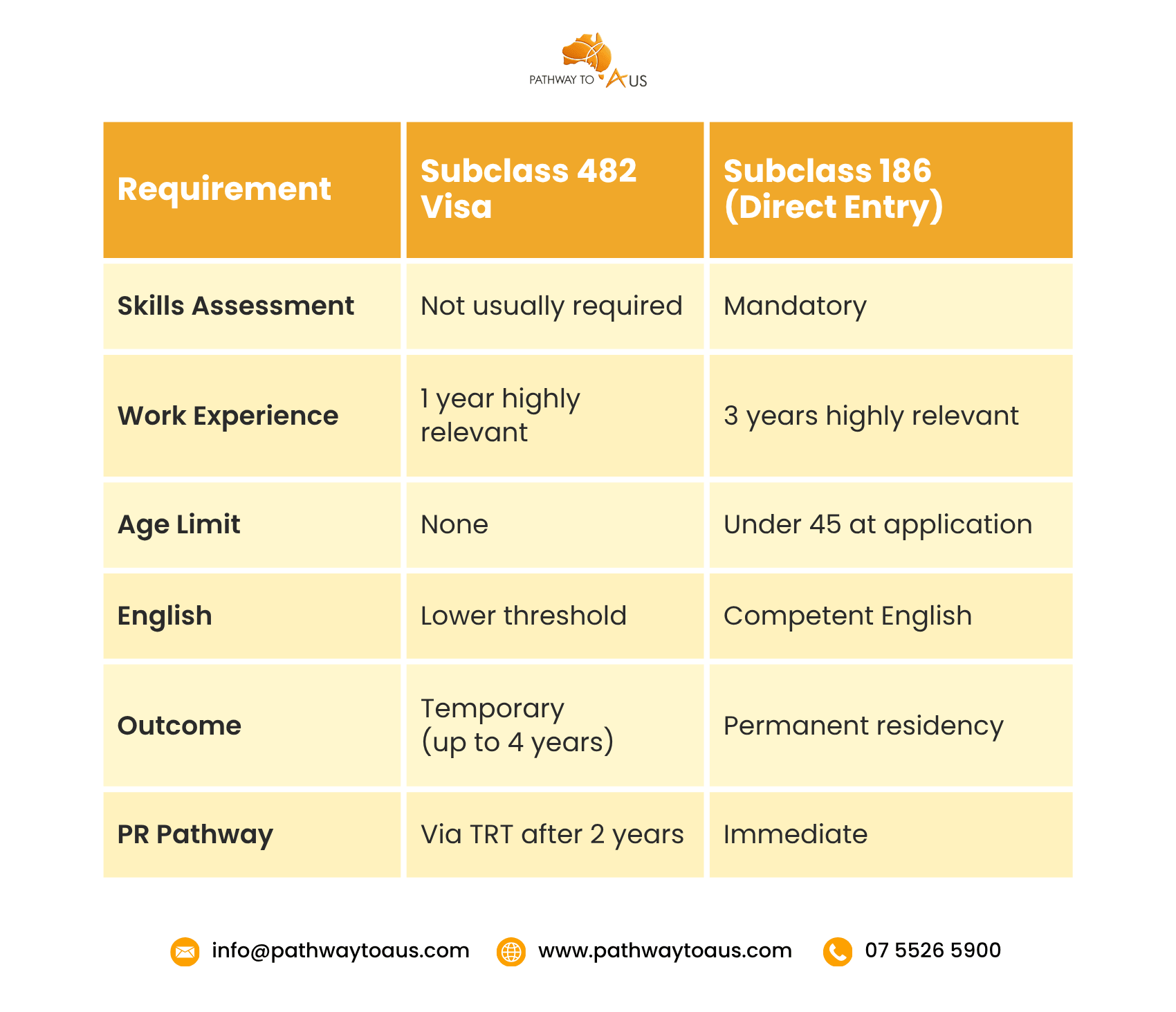
Experience and Skills Assessment
The 186 Direct Entry stream requires a positive skills assessment from the relevant assessing authority, along with at least 3 years of relevant work experience in the nominated occupation. While that sounds achievable on paper, it is not always the case in real life. Many skilled workers we speak with find their experience is either too broad, too junior, or not documented in the way an assessing body needs to see it.
The Subclass 482, however, normally doesn’t require a skills assessment. Some professions still do, so it’s worth examining the details of your employment, but for most applicants only one year of very relevant experience is required.
This one distinction is what makes the 482 visa the genuine on-ramp for a big group of workers who are otherwise ready to contribute, and it explains why so many long-term Australian residents started on this visa rather than jumping straight to permanent status.
Age Limits
The 186 Direct Entry has a firm cap: you must be under 45 at the time of application. There is no negotiating this in the standard program. The Subclass 482 has no such age limit at all, which changes the conversation entirely for anyone in their forties or fifties.
If you are 42 and considering PR, your window for the Direct Entry option is narrower than you might think, since preparation, skills assessments, and nomination all take time.
Starting on a 482 keeps your options open, because it allows you to work in Australia while positioning yourself for the TRT route, which also has an under-45 age requirement but may offer exemptions that are not available under the Direct Entry stream.
You should seek advice on whether an exemption applies to your circumstances. What looks like a delay on the surface can, in the right circumstances, be the pathway that actually gets you there.
English Language Requirements
The 186 requires Competent English, generally an IELTS score of 6 in each band or equivalent. The 482 sits at a lower threshold for most streams, which gives applicants a little more room to move while they continue improving their language skills.
It is a small distinction on paper, but a failed English test late in a permanent visa application can undo months of preparation, and this is one of the more common reasons we see 186 Direct Entry applications stall.
Requirements For A Company To Sponsor A 482 Visa Holder
What your Australian employer needs to have in place before they can lawfully sponsor you.
From 482 to Permanent Residency: The TRT Pathway
The TRT stream 186 is the bridge many of our clients ultimately use, and understanding how it works is central to the 482 to 186 pathway question.
To be considered, you generally need to have held your 482 visa and worked for your sponsoring employer for at least two years in the same nominated occupation, with your employer willing to nominate you for the permanent visa.
The advantages are real: a lower experience threshold than Direct Entry, no separate skills assessment in most cases, important to note though the TRT stream itself has an age requirement, with exemptions available in some circumstances..
In practice, the sequence looks like this: you arrive on a 482, work in your nominated role for two years, and then your employer nominates you for the 186 TRT. Outcomes are never guaranteed, since every case turns on its own facts, but for many workers this is the more forgiving route to permanent residency.
482 Visa Rejected: The 3 Mistakes Behind Most Refusals
The employer-side missteps we see repeatedly, and how to avoid them before you lodge.
Why Employers Sometimes Prefer the 482
Sponsoring someone for a permanent visa is a bigger commitment than many firms want to undertake at first. A longer term business case is required for nominations for a permanent visa and some firms are reluctant to sponsor a candidate they have not worked with on a day-to-day basis.
The 482 allows both sides a little leeway. The firm understands the position’s fit to their business over a number of years, the worker builds a track record locally in Australia, and the 186 TRT door stays open. So when clients ask about how to get sponsored in Australia, we typically tell them to start the conversation on the 482 rather than pressing for permanent sponsorship on day one.
A Simple Way to Choose
Under 45, three years of highly relevant experience, and a positive skills assessment? The 186 Direct Entry is often the fastest route.
Employer ready, but you are short on experience or lack a skills assessment? The 482 first, then the 186 TRT stream, tends to be the sensible sequence.
Over 45 on the 482? The 186 Direct Entry is closed and the 186 TRT stream has an age limit of under 45, but exceptions can be made in some cases. You are highly advised to take professional guidance.
Not sure if your experience is "highly relevant"? The 482 reduces the possibility of a permanent application being denied while you are building your case.
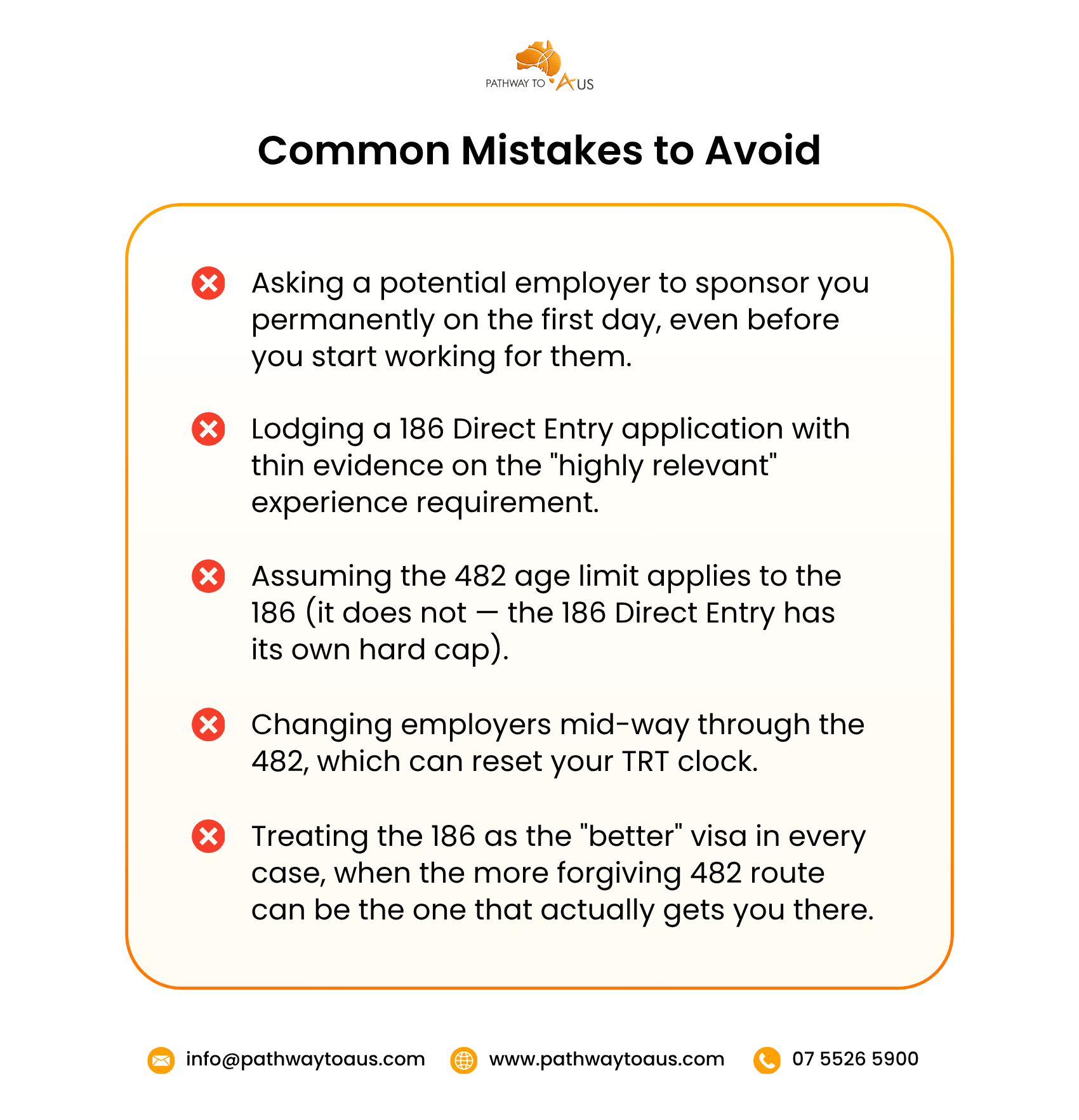
Common Mistakes to Avoid
How Pathway to Aus Can Help
Our team works on subclass 482 vs 186 visa Australia decisions every week. We look at your work history, job, English level, age, and your employer's ability to sponsor. Then we figure out the best way for you to get here under the current rules.
If you are trying to decide between the 482 visa and the 186 visa for Australia and want a professional opinion on your choices, book a meeting with our team. We will help you see where you stand before you choose a path.
Frequently Asked Questions
Can I apply for a 186 visa while I am on a 482 visa?
You can apply for the Subclass 186 while holding a 482. You can do so through the Direct Entry stream if you meet the standard requirements or through the Temporary Residence Transition stream after working for the appropriate amount of time in the same chosen industry for your sponsoring employer.
How much does the 482 to 186 visa transition cost in Australia?
The government fees alone can be more than AUD 4,700 for the main applicant under section 186. This is on top of the employer's nomination fees and the Skilling Australians Fund levy. The total costs usually go up even more when family members, English tests, and professional migration advice are taken into account.
Does the 482 visa lead to Australian citizenship?
The 482 does not directly lead to citizenship, but it can lead to permanent residency through the 186 TRT stream. Once you have had PR for the required amount of time, you may be able to apply for Australian citizenship.
How long does it take to move from a 482 visa to permanent residency?
The government fees alone can be more than AUD 4,700 for the main applicant under section 186. This is on top of the employer's nomination fees and the Skilling Australians Fund levy. The total costs usually go up even more when family members, English tests, and professional migration advice are taken into account.
Is the 482 visa tied to one employer only?
The 482 is nominated by a specific approved sponsor, so your work rights are tied to that role, though you may transfer to a new sponsor if they lodge a fresh nomination for you, which is an important consideration when you are counting time toward the 186 TRT pathway.