

If you’re thinking of a career with young children, deciding to study childcare in Australia could be one of the most practical decisions you make. The training is built from the beginning on real centres, real families, real children.
Many of the students we guide at Pathway to Aus arrive with a love of working with kids but little sense of how the qualifications connect, and that is where clear advice tends to save the most time and money. In this guide, we walk you through the courses, skills, career steps and visa planning behind a strong start.
At a glance
| Topic | Key information |
| Entry-level qualification | Certificate III in Early Childhood Education and Care (CHC30121 ) |
| Next qualification | Diploma of Early Childhood Education and Care |
| Work placement | At least 160 hours (Certificate III) and 280 hours (Diploma) |
| Where educators work | Long day care, family day care, preschools and kindergartens |
| Visa for international students | Student visa (subclass 500), applied for after you receive your Confirmation of Enrolment |
Not sure where to start?
Our registered education and migration agents offer free advice on courses, study pathways and student visas. Book a free consultation.
Key Takeaways
- To study childcare in Australia, most students start with the Certificate III and progress to the Diploma.
- Both qualifications include compulsory work placement in a regulated childcare service.
- Career steps may run from assistant educator to room leader, educational leader and centre director.
- Your course and student visa should be planned together, and study does not guarantee permanent residency.
Which Qualification is Right for You?
The starting point depends on your goals and the study you have already done. Most students start with Certificate III, the entry-level qualification for working as an early childhood educator. The Certificate III is a common stepping stone to the Diploma, which builds on the same foundations and adds more emphasis on designing and delivering educational programs and, in some cases, supervising other educators or volunteers.
| Qualification | Roles it may lead to |
|---|---|
| Certificate III |
Early childhood assistant educator Early childhood educator or family day care educator |
| Diploma | Once qualified, diploma holders can take on roles such as room leader (running the room), lead educator, assistant director or centre director, with entry-level management knowledge that supports leading the operation of an early childhood service. |
To get into the Diploma, you usually need a Certificate III in Early Childhood Education and Care. There are other entry options listed in the national qualification. Many students take both courses together as one continuous journey, which could make their study timeline more manageable.
If teaching interests you, further study at degree level may lead to working as an early childhood teacher. Our Bachelor of Early Childhood Education and Graduate Diploma in Early Childhood Education pages explain these options.
Compare the courses in detail
See entry requirements and study options for the Certificate III or the Diploma.
What You Learn and How Placement Works
Early childhood education and care qualifications are designed around the work educators do in regulated children’s services. At Certificate III level, you learn to provide education and care to children, contribute to educational programs, and work closely with families and the wider community. The course also includes a unit on working with diverse people, reflecting the variety of backgrounds you will encounter in Australian services. Gabby got a closer look at this when she visited KKTC, where the team shared what students learn throughout the course.
At Diploma level the focus broadens to include supporting children’s learning and development, designing and evaluating programs and supporting the health and wellbeing of children and their families.
Work placement, including child safety training, is a formal component of every qualification. These hours are part of your course, and so it's worth asking each college how they support students with arranging placements before you enrol.
Your choice of course is also related to how the sector is regulated. Early childhood services are licensed under the National Quality Framework and have staff who have (or are working towards) a nationally approved qualification. The Australian Children’s Education and Care Quality Authority (ACECQA) publishes the list of approved qualifications.
For a broader view of the sector, our guide to working as a childcare worker in Australia covers qualifications and career options in more detail.
Planning Your Student Visa
If you are applying from abroad, you should ideally start your course and visa planning at the same time. You first need to enrol with an Australian education provider and receive a Confirmation of Enrolment (CoE), and then you can apply for your Student visa (subclass 500). You will need to prove that you are genuinely intending to study and may need to provide evidence of your financial resources and proficiency in English.
New Student Visa Rules
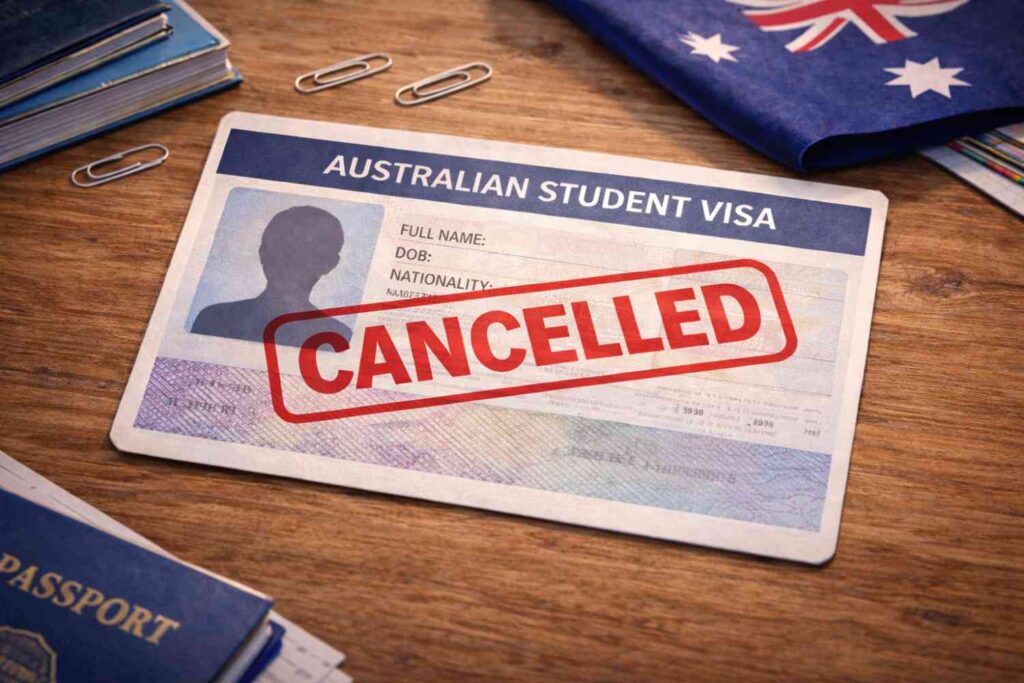
From 2 October 2026, most temporary visa holders can no longer apply for a Student visa while in Australia, so if you are currently in Australia on another visa, check whether you can still apply onshore before making plans. Student visa applicants also can no longer include a partner or dependent children in their application or add them after the visa is granted, and Home Affairs has confirmed there are no exemptions to this rule.
Applications lodged before 2 October 2026 are assessed under the previous rules, and current Student visas are not affected. You can find the full list of affected visas and exemptions on the Department of Home Affairs’ Subclass 500 Student visa page.
Student visa holders can work up to 48 hours a fortnight when their course is in session and unlimited hours during scheduled course breaks. You also need to have adequate health insurance for the whole length of your stay. You can check your visa conditions at any time by using the Department of Home Affairs’ VEVO system.
Check your budget early
Our Evidence of Financial Capacity calculator gives you a starting estimate of the funds you may need to show.
You might want to look into other visa options like the Temporary Graduate visa (subclass 485) when you finish your studies. Your eligibility for any visa will be based on your qualification, your circumstances and the criteria at the time you apply. Our Graduate Visa to PR journey guide explains how this next stage generally works.
How this looks in practice
Ingrid came from Malaysia to study childcare on the Gold Coast. She completed the Certificate III and Diploma along with her vocational placement, then applied for her graduate visa with our team's support. You can read her interview here.
Ready to plan your visa?
Students who enrol in a course through Pathway to Aus receive free student visa assistance from a registered migration agent. Government visa charges are paid separately. Talk to a registered migration agent
How to Choose a College
Each college has their own way of teaching and placement. So comparing a few options will help you find the right fit. Useful points of comparison are:
- CRICOS registration for your course, which allows the college to enrol student visa holders
- How the college supports you in arranging your work placement
- Whether the course appears on ACECQA's approved qualifications list
- Course duration, intakes, entry requirements and fees
In Queensland, for example, Kool Kids Training College (KKTC) is registered on CRICOS to offer both the Certificate III and the Diploma of Early Childhood Education and Care to international students, with rolling intakes.
Want help comparing colleges?
We can talk you through providers, intakes and placement support, and help with your school application at no cost. Get free course advice
Your Next Steps
A well-defined sequence can help you confidently move from interest to enrolment:
- Choose the qualification level that best aligns with your goals, whether it be the Certificate III alone or the Certificate III with the Diploma.
- Ensure the course you choose is on ACECQA’s list of approved qualifications.
- Make sure the college is CRICOS-registered for the course you want.
- Enrol and get your Confirmation of Enrolment.
- Prepare and submit your Student visa application, generally, from outside Australia.
Embark on your childcare journey with us.
Share your background, goals and budget, and our team can help you map out a study plan that suits you. Book your free consultation
Frequently Asked Questions
Can my partner work while I study in Australia?
Only if your partner can be included in your visa. From 2 October 2026, most new Student visa applicants can’t include a partner, unless they’re a doctoral student, an ASEAN or Pacific national, a fully funded foreign government scholar, or sponsored by DFAT or Defence. Partners also can’t be added after the visa is granted.
If included, your partner may work up to 48 hours per fortnight, or unlimited hours if you study a Master by Research or PhD.
How long does it take to become a childcare worker in Australia?
Course length varies by provider and study load. For example, KKTC lists the Certificate III at 38 weeks and the Diploma at 56 weeks, about 94 weeks of study in total plus scheduled breaks. Check the duration on your provider’s listing.
What IELTS score do I need to study childcare in Australia?
Many colleges require an overall IELTS score of around 5.5 (or an equivalent test) to enter Certificate III. Each provider will have different requirements. Your student visa may also have English requirements.
How much does a childcare course cost in Australia for international students?
Tuition for vocational childcare courses generally ranges from $10,000 to $15,000 per year, depending on the provider and location. You will also have to budget for living costs, health cover and visa fees.
Do I need a Working with Children Check to study childcare in Australia?
Yes, you will typically need to have a valid Working with Children Check to start your work placement. Each state has their own check, and in Queensland this is known as a blue card.
Do you need a degree to be an early childhood teacher in Australia?
Yes. Early childhood teachers require an early childhood teaching qualification approved by ACECQA, typically a bachelor degree or graduate diploma. Certificate III or Diploma makes you an educator, not a teacher.