


If you want to become a chef in Australia, and eventually run a kitchen rather than just work one, the pathway you choose early on matters more than most students realise. Chefs have sat on Australia's national occupation shortage list for four consecutive years, and by early 2026, job listings on Seek showed more than 5,000 open chef roles, according to figures cited by the Australian Hotels Association.
That demand isn't just for line cooks. Kitchens are increasingly short on people who can cook well and manage a section, a shift, or eventually a whole operation, which is precisely the gap a Certificate IV in Kitchen Management is built to close.
At Pathway to Aus, we talk to international students weighing up cookery pathways every week, and the Kitchen Management route tends to suit a specific kind of student: someone who wants their training to build toward leadership, not just technique. Here's how that pathway actually works, and what to look for in a course that delivers on it.
Key Takeaways
- Australia’s national occupation shortage list has had chefs on it for four years, with more than 5,000 chef vacancies advertised on Seek in early 2026.
- Certificate IV in Kitchen Management builds on core cookery skills with supervision, costing and menu management and prepares students for leadership roles rather than line-cook work.
- Strong programs treat dietary-specific cooking, like gluten-free or coeliac-friendly dishes, as a core skill, not an occasional extra.
- The progression of a career from Kitchen Management study to head chef is very much dependent on the hands on kitchen experience gained alongside the qualification.
- Cookery and kitchen management study may factor into a longer-term migration pathway, though outcomes depend on individual circumstances and current policy.
How Certificate IV in Kitchen Management Builds on Commercial Cookery Skills
A Certificate III in Commercial Cookery will train you to cook well under commercial conditions. The Certificate IV in Kitchen Management in contrast, takes that base and adds something different, the skills to run a section, coordinate a team and understand the business side of a kitchen, costing, stock control and menu planning to name a few.
That combination means more than it might seem at first. Head chefs and kitchen managers are not just the best cooks in the room. They are the ones that can hold a menu together at a fixed food cost, manage a roster under pressure, and keep quality up on a Saturday night when the kitchen is not fully staffed.
Choosing Kitchen Management as your route to becoming a chef in Australia is, in effect, choosing to train for that fuller role from the outset, rather than picking it up piecemeal once you're already working.
How Studying Cookery Can Lead to PR
A closer look at how a cookery qualification can factor into a longer-term migration pathway.
What the Certificate IV in Kitchen Management Actually Teaches
The best programs provide this training in a real commercial kitchen, not a mock teaching space, and the difference is clearly reflected in what students are expected to produce. Instead of churning out simple, standardised dishes, students on a well-run Kitchen Management course are generally encouraged to attempt more challenging, technically demanding work: Pasta from scratch, for example, along with dishes adapted to specific dietary requirements, like gluten-free carbonara or a coeliac-friendly chicken schnitzel among them.
That dietary-specific work isn't a side note. Managing allergen and intolerance requirements competently has become a genuine, everyday skill in Australian kitchens, and training that treats it as central, rather than an occasional exception, tends to produce graduates who are more useful from day one. It also reflects the reality of the role you're training for. A kitchen manager who can only cook the standard menu isn't managing much of anything once a special request comes in.
Trainers with recent, hands-on industry experience tend to make a real difference here too. Someone who has run a kitchen recently understands the pressure points, the dietary complexity, the staffing gaps, in a way that's hard to teach from a textbook alone.
From Kitchen Management to Head Chef: How the Career Progresses
Most students don't walk straight from a Certificate IV into a head chef title, and it's worth being realistic about that. What the qualification does is position you for the roles that lead there.
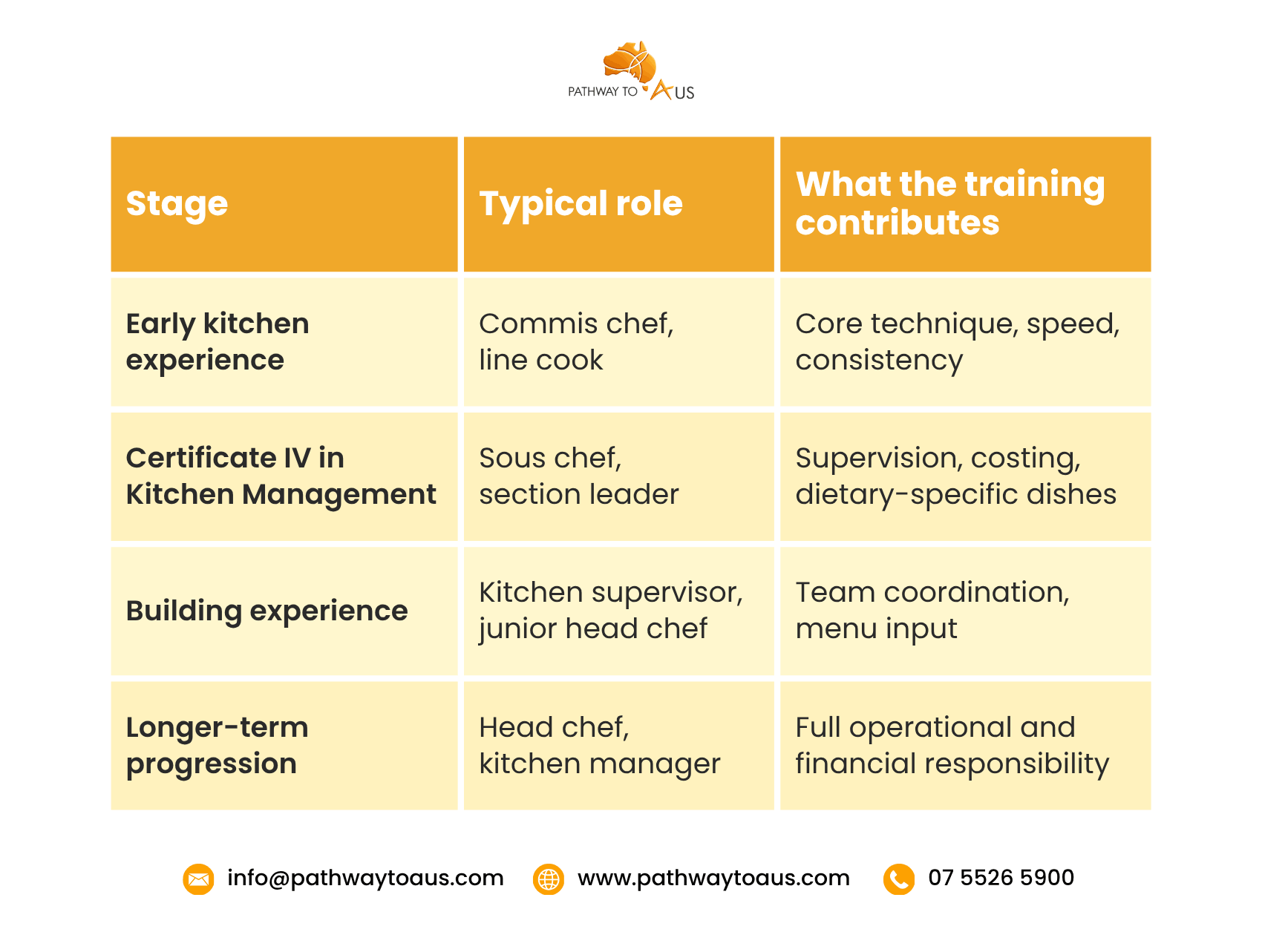
Progression through these stages depends heavily on the actual kitchen experience you accumulate alongside your qualification, not the certificate on its own. Students who want kitchens with real mentorship, not just the first job that comes along, often move through this progression quicker because they are learning from someone who is actively invested in them.
How Much Is a Commercial Cookery Course?
A quick FAQ answer on budgeting for your qualification before you commit to a provider.
What to Look for in a Kitchen Management Provider
Not every Certificate IV in Kitchen Management is delivered to the same standard, so it's worth being selective. A few things genuinely matter:
- A real, functioning commercial kitchen, where students cook under conditions that resemble actual service, not a static demonstration space
- A curriculum that treats dietary-specific cooking as core, not optional, given how standard these requests have become in professional kitchens
- Trainers with recent industry experience, ideally still connected to working kitchens
- CRICOS registration, confirming the provider can legally enrol international students
- Support services for international students, since a demanding practical course is easier to navigate with guidance available alongside it
Comparing providers against criteria like these is often where our early conversations with students add the most value. Our team at Pathway to Aus helps you weigh up these factors properly, so the course you choose genuinely prepares you for kitchen leadership, rather than simply issuing a certificate.
Thinking About the Longer Term
Cookery and kitchen management qualifications have, at various points, featured on occupation lists relevant to migration, and that's part of why interest in this pathway remains strong among international students. However, migration policy and occupation lists shift over time, and eligibility depends on individual circumstances, so it would be misleading to present any course as a guaranteed route to a visa outcome.
We'd always encourage you to treat your training as a genuine investment in a career you want to build, and to get tailored, current advice on migration options separately, rather than assuming one follows automatically from the other.
What we can say with more confidence is that the leadership and technical skills built through a Kitchen Management qualification are genuinely transferable, useful whether you're aiming for a head chef role, further hospitality management study, or exploring migration pathways down the track.
Our team at Pathway to Aus supports students across each of these stages, from course selection through to skills assessments and visa guidance.
Australia 189 Visa: Top Courses for PR in 2026
A broader look at how cookery compares to other course options for PR-focused students.
Getting Started With Your Culinary Journey in Australia
If you want to be a chef in Australia and be the boss of a kitchen one day, then the Kitchen Management route is something to seriously consider, rather than just an afterthought to the normal Certificate III path.
Often the most useful next step is a direct conversation about your background, your goals and which providers are worth shortlisting. That’s the kind of conversation our team at Pathway to Aus is designed to have.
Frequently Asked Questions
What is the difference between a chef and a kitchen manager in Australia?
Generally, a chef is in charge of food preparation and menu execution. A kitchen manager generally also handles staffing, costing and daily operations, although in smaller kitchens, these responsibilities are combined into one person.
Is a Certificate IV in Kitchen Management worth it in Australia?
If you want to be a supervisor or head chef rather than a line cook, the extra business and leadership skills that you get in a Certificate IV are usually worth the step up from a Certificate III on its own.
Can you skip Certificate III and go straight into Kitchen Management study?
The foundational cookery skills covered in a Certificate III are assumed or required for most Kitchen Management programs and so this is generally treated as a progression rather than an alternative starting point.
How much can a kitchen manager earn in Australia?
Kitchen manager pay varies widely by venue and location, as well as by the manager’s level of experience, but it is generally higher than line cook pay because of the additional supervisory and operational responsibilities.
What soft skills matter most for a kitchen manager in Australia?
Once a chef is in a supervisory or management position, good communication, the ability to stay calm under pressure and clear delegation tend to matter as much as technical cooking skill.