


If you’re comparing Australian PR vs citizenship, you are likely already considering the long-term aspects of living in Australia rather than just the initial visa award.
Permanent residency in Australia provides a solid base, but citizenship carries a distinct degree of assurance, participation, and freedom, so that is typically where the real talk starts.
If you know the difference, you can make choices that are best for your family, career, and plans for the future instead of just chasing a label.
We get this question a lot here at Pathway to Aus. This question comes from people who are still studying, skilled migrating, or being sponsored by a job to get PR. There are also people who already have PR and want to know if citizenship is the next step that makes sense.
Our job isn't to force one outcome on everyone; it's to help you understand the road you have in front of you, carefully check your eligibility, and make a plan that works for you.
Key Takeaways:
- Permanent residency in Australia gives you the right to live, work, study and access Medicare indefinitely, but it is legally different from citizenship.
- Australian citizens hold an Australian passport, vote in federal elections and can return to Australia at any time without a travel facility, none of which apply the same way to permanent residents.
- PR is typically the pathway to citizenship by conferral, which requires four years of lawful residence in Australia and the last twelve months on a permanent visa immediately before applying.
- Whether PR is the right destination or citizenship is the sensible next step depends on your travel patterns, career direction and long-term ties to Australia.
What is Australian Permanent Residency?
Most of the time, having permanent residency in Australia means you have a visa that lets you stay in the country forever. That means you can usually live, work, study, and enrol in Medicare. In some cases, you can also bring qualified family members to live with you, and later, if you meet the legal requirements, you can apply for citizenship.
PR is a big step forward, which is why so many refugees see it as a big accomplishment rather than a short-term stop. But it's still not the same as citizenship or protected residency.
Even if you live in Australia permanently and have a visa, you are still not a citizen. This is the most important legal difference when you travel, look at your rights as a citizen, and plan your future in and out of Australia. Sometimes it seems like the status will always be the same, but some of its most important rules are only clear when things change.
What is Australian Citizenship?
By law, being an Australian citizen means being a full member of the Australian community. Not only does it change how you can stay in the country, but it also changes how the country sees you.
So, when people talk about benefits for Australian citizens, they don't just talk about ease of use. They also talk about safety, identity, and a sense of long-term belonging.
The Department of Home Affairs says that becoming a citizen can happen in a number of ways. The most popular are conferral and descent. For most migrants who first become permanent residents, citizenship by conferral is the relevant route.
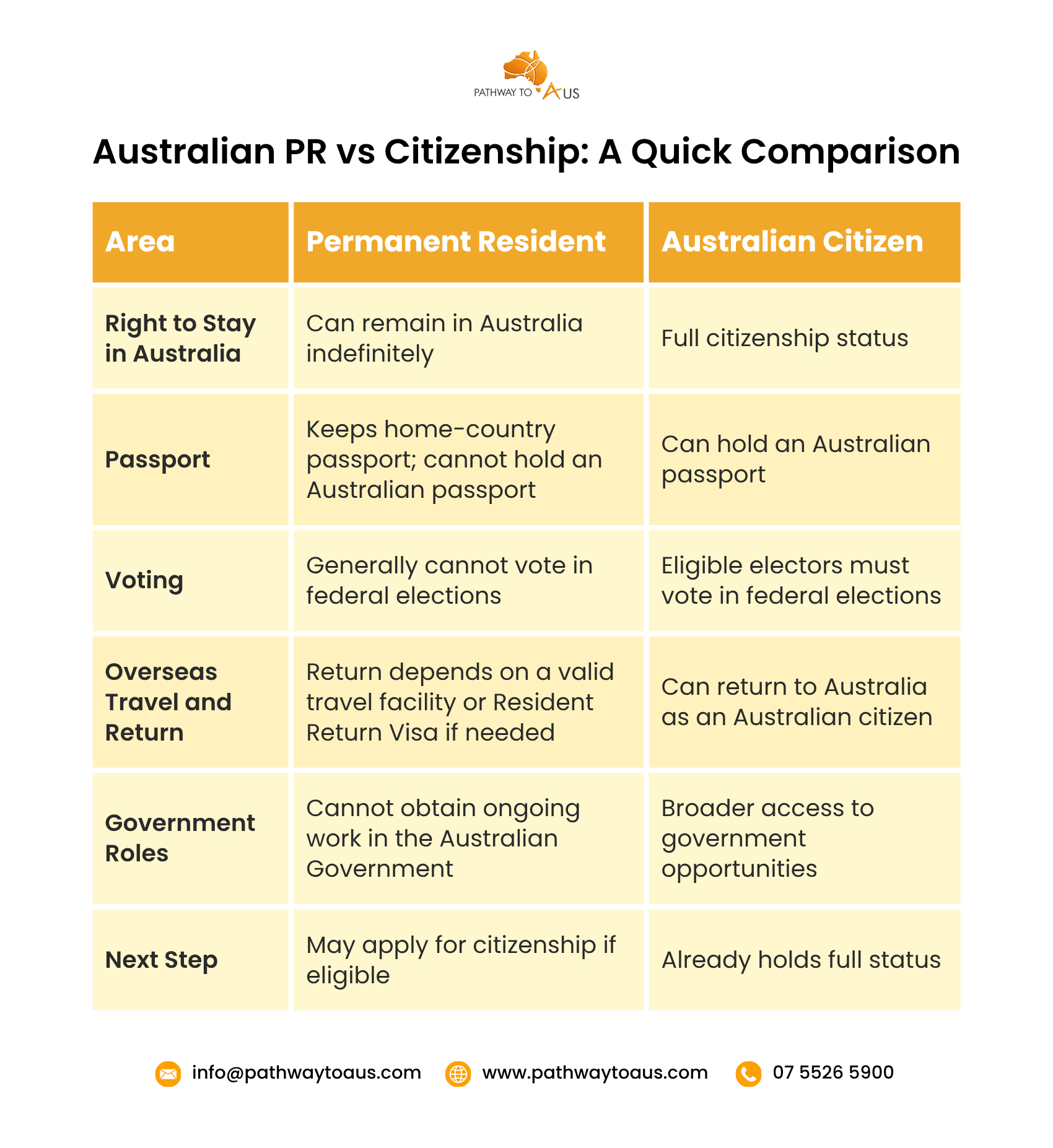
Australian PR vs Citizenship: A Quick Comparison
How to Apply for Australian Citizenship
Once you've held permanent residency long enough to meet the general residence requirement, the next question is how the citizenship application actually works. This guide walks you through the eligibility rules, the residence test, the citizenship test itself and the paperwork you need to prepare.
5 Key Differences Between PR and Citizenship in Australia
A big question that a lot of people have about PR status is whether it immediately makes you an Australian citizen.
PR gives you the security to live, work, and build your future here. Citizenship goes even further and affects how easily you can move around, take part, and make plans with confidence. Getting a better sense of the main differences can help you pick the right road.
1. Passport and Travel Identity
The passport you use to travel is one of the most obvious distinctions between Australian citizenship and permanent residence.
You typically cannot have an Australian passport if you are a permanent resident; instead, you must keep the passport of your home country. You can travel with an Australian passport as a citizen, which modifies both your official status upon entering Australia and your travel document.
At first, the distinction may seem administrative, but the more globally mobile your life is, the more significant it becomes. Your immigration status is now more about how easy you can leave and return tomorrow than it is about where you currently reside if your employment, family, or business obligations need you to travel abroad on a frequent basis.
2. Voting and Civic Participation
Another distinction between Australian citizenship and PR is getting the right to vote. Permanent residents usually can't vote in Australian Government elections, but eligible Australian citizens must register and vote in federal elections. There are a few exceptions, like British subjects who registered before January 26, 1984.
That is important because citizenship is more than just a legal position; it's also a civic one. You are no longer just building your life within Australia's system once you can vote. It's because of you that that system is formed.
3. Living Overseas and Returning to Australia
This is the part of PR that people get wrong most of the time. People who live in Australia permanently can stay there for as long as they want, but they can't move as much as other people.
You might need a Resident Return Visa to come back as a permanent resident if your travel document runs out while you are abroad. They also say that if you don't have a valid visa, you won't be able to enter Australia unless you are a citizen of Australia.
This is where PR can feel less long-lasting than a lot of people think it will. Even if you live in Australia, own property here, and have built a job here, spending a long time outside of Australia can still cause visa problems.
Citizenship takes away a lot of that uncertainty, which is why people whose lives are spread out in different countries often like it.
4. Government Jobs and Long-term Access
Permanent residents in Australia can do many things, but there are some things they can't do. According to Home Affairs, permanent residents usually can't get stable jobs with the Australian Government.
Some people won't care much about that point, but for others, especially those who want to work in public service or other sensitive fields for a long time, it can have a bigger impact on their future choices than they thought.
5. Visa Status and Legal Security
Because a permanent resident still holds a visa, visa law is still important. The Department of Home Affairs makes it clear that non-citizens can have their visas revoked in certain situations, such as if they have serious character issues.
Citizenship sits differently because a citizen is not present in Australia by holding a visa in the same way.
It's not true that all permanent residents are at the same amount of risk, and the language used shouldn't be alarmist. It does mean that PR and citizenship are two different things in the eyes of the law, and that difference is clearest when things go wrong and not when everything is going well.
Why Many Migrants Use PR as the Pathway to an Australian Citizenship
For most migrants, PR is not the end of the road but the stage that makes the next stage possible. It gives you the stability to work, study, settle your family and build a record of lawful residence in Australia. Over time, that can become the pathway to an Australian citizenship, provided you meet the relevant requirements.
For citizenship by conferral under the general residence requirement, you must have lived in Australia on a valid visa for four years immediately before applying, held a permanent visa or eligible Special Category visa for the last 12 months immediately before applying, and stayed within the permitted absence limits.
That is why your broader migration strategy matters. Getting the right student visa, graduate visa, employer-sponsored visa, or skilled migration route can change how you stay in Australia now and how likely it is that you will become a citizen down the road.
We help our clients plan for the long term at Pathway to Aus. This could mean looking into a partner visa, a student visa, a graduate visa, General Skilled Migration, or a choice like the Subclass 186 visa that is sponsored by an employer.
When PR May be Enough for You
There are people for whom PR is exactly the right outcome for the time being. You may want the right to live and work in Australia without taking on the immediate step of citizenship.
For many, that level of security is the main goal, especially when the main goal right now is to settle down, make professional progress, and build a stronger foundation for the long run.
You may not yet meet the residence requirement. Or you may be balancing personal, tax, family or nationality considerations that mean waiting is the wiser move.
That kind of pause is not a failure to progress. When planning to migrate, timing is often just as important as where to go. You should know exactly what PR can't do so that your choice is well-thought-out and not just based on assumptions.
Debraj's Journey — Student Visa to Subclass 186 PR
Debraj arrived in Australia as an international student and worked his way through study, employer sponsorship and eventually a permanent Subclass 186 visa. His story shows how PR can be the settled endpoint many migrants are actually looking for, without needing to rush into the next stage.
When Citizenship may Become the Better Option
Being an Australian citizen often starts to look more appealing as your ties to the country get stronger and last longer. If you want an Australian passport, the freedom to move back and forth without any problems, the right to vote, or the higher status that comes with being a full legal member, citizenship may be the best long-term choice.
It's important not to think that you automatically become a citizen just because you have PR. You might be able to get a visa if you meet the character requirements, live in the right country, and attach all the necessary documents to your application.
Getting good help is important for this reason, especially if your path has involved multiple visas, time spent abroad, or strange timing problems.
Graduate Visa to PR via Queensland Nomination
Gabi and her husband moved from a graduate work visa through to permanent residency via Queensland state nomination, and now see citizenship as the natural next stage of settling in Australia. Her story is a working example of when the shift from PR to citizenship starts to make sense.
How Pathway to Aus Can Help
Most of the time, the debate between Australian PR vs. Citizenship isn't about which status sounds better. It's about how you plan to stay, work, travel, and live in Australia for a long time.
PR gives you a real platform and important rights. Being a citizen goes even further, giving you more security and rights that grow in value as your life in Australia changes.
Pathway to Aus is a registered migration agency that has helped over 1,000 people from 50 different countries. We have registered migration agents and specialists in skilled migration, employer-sponsored pathways, graduate visas, study pathways, and family visas whom you can talk to figure out where you are now and what you might do next.
You can look into Pathway to Aus, our visa services, or read more about how to apply for Australian citizenship before you decide what to do next.
Frequently Asked Questions
How long can you be a permanent resident in Australia?
If you have a permanent visa, you can stay in Australia forever. The travel facility on your permanent visa determines whether you can come back after travelling abroad. When you get your first permanent visa, you usually get a 5-year travel facility. If it has expired, you may need a Resident Return visa to come back as a permanent resident.
How long after PR do you get citizenship in Australia?
Australian citizenship is not granted automatically after a set PR period. Under the general residence requirement, most applicants must have lived in Australia on a valid visa for 4 years immediately before applying, including the last 12 months as a permanent visa holder or eligible SCV holder, and must meet the absence limits.
Does permanent residence expire?
With a permanent visa, you can stay in Australia for as long as you want. It doesn't expire like a temporary visa does. The travel permit can end, though, which means that you can't come back from abroad, and in some cases, a permanent visa can also be revoked.
Who qualifies for permanent residence?
You can become a permanent resident of Australia without meeting a single test. Your eligibility depends on the type of permanent visa you apply for. The common pathways include family-stream, work-stream, and business or investment-stream permanent visas, with examples including some skilled and employer-sponsored visas.
Can someone lose their permanent residency?
Yes, a permanent visa can be revoked. It is possible for a visa to be revoked if the applicant does not follow the rules, gives false or incorrect information, poses a threat to the Australian community, commits a crime, or fails to meet character standards.
Can I be deported if I have permanent residency?
Some people can be detained by immigration officials and sent back to their home country if their permanent visa is revoked.
Do I lose my Australian citizenship if I become a citizen of another country?
Not all the time. If you become a citizen of another country, you do not automatically lose your Australian citizenship. However, the laws of that other country may be different.
What jobs can get you permanent residency in Australia?
No single job guarantees permanent residence in Australia. Eligibility depends on the visa pathway, but work-based PR options commonly involve occupations on a skilled occupation list or permanent visa pathways such as employer-sponsored and skilled nominated visas.
What is the 88 day rule in Australia?
The “88 day rule” usually refers to the minimum 3 months of specified work needed for a second Working Holiday visa, which Home Affairs defines as at least 88 calendar days, including weekends or equivalent rest days during the employment period. Home Affairs also states that UK passport holders who lodge a subclass 417 application on or after 1 July 2024 do not need to meet the specified work requirement for a second or third visa.