


If your plan for getting permanent residency in Australia leans heavily on short courses and secondary accreditations, you need to read this carefully.
The Government is signaling a clear shift away from a points system that rewarded time spent in Australia at the expense of genuine workforce contribution, and the early direction is unmistakable: future reform will place weight on youth, superior English ability, and real Australian work experience rather than on stacked credential points.
We watch these signals closely, because once a points reform is legislated, it's already too late to restructure last year's strategy. Here's what the current Australian PR points review is pointing toward, and what that means for where you sit today.
Key Takeaways:
- The Australian Government is signaling a major shift in how Australian PR points are awarded, with less weight on short courses and secondary accreditations and more weight on youth, English ability and Australian work experience.
- Professional Year and NAATI CCL points sit under active review, and regional study and general Australian study points may also be reshaped in the reformed framework.
- Applicants under 33, holding Superior English at IELTS 8 or PTE 79+, and with several years of skilled Australian work experience are best positioned under the direction the review is pointing toward.
- The reform is not yet legislated, so the practical move today is to lock in your strongest English score, build genuine skilled experience, and avoid stacking "points-only" courses without a wider plan.
- The applicants who come out ahead in any points reform are the ones who read the signals early and adjust their strategy while there is still time to do so sensibly.
Why the Government Wants to Change the Points Test
The Migration Strategy and the program planning levels published by the Department of Home Affairs make one theme consistent.
The current framework, in their view, rewards what the Government has taken to calling "permanent temporariness": applicants collecting short courses, bonus accreditations and extended temporary stays purely to gather points, without anchoring to a high-value contribution to the Australian labour market.
The Migration Strategy and the review discussion paper indicate a direction toward selecting migrants with high human capital, and stakeholder submissions and modelling (including from the Grattan Institute) argue for stronger weighting on younger applicants, higher-band English, and skilled work in Australia at strong income levels.
That signals a future system designed around contribution rather than credential stacking, and the review is being shaped by the very intent already visible in how the migration program is being planned year on year.
What Could Actually Change
Nothing in the points test is yet legislated, but the review papers and stakeholder submissions point to a consistent direction across several categories. Here is how the framework sits today, and where the signals suggest it is moving.
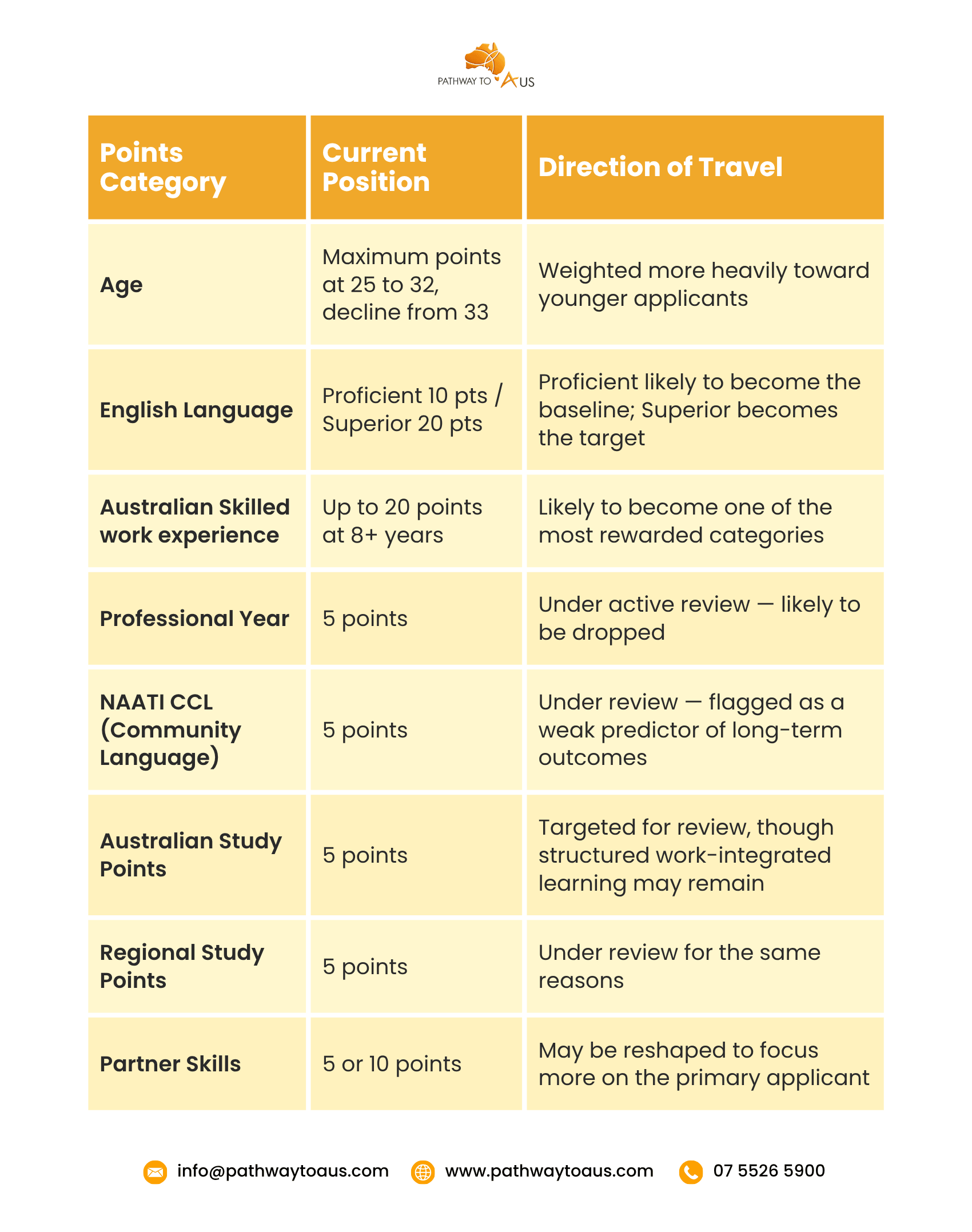
Read that table once through, twice if your strategy leans on one of the upper rows.
NAATI Credentialed Community Language, Professional Year, Australian study and regional study points are precisely the categories the Government is questioning whether they predict the kind of long-term contribution Australia wants from its migrants.
How to Increase Your Points for the 189 Visa
The points test rewards a few categories heavily and many categories only a little. This guide breaks down where the gains actually live in 2026 and how to use the highest-value moves first.
Who Actually Wins Under the New System
Three groups are positioned to come out ahead:
1. Younger Applicants (20s to early 30s)
Younger applicants in their 20s or early 30s sit in the age band where maximum points are already weighted, and the review suggests that weighting will sharpen further. The Government's reasoning is straightforward: a longer Australian earning horizon, more years of tax contribution, more years building a career locally.
2. Applicants with Superior English
Superior English (IELTS 8, or the current PTE Academic thresholds — 69 listening / 70 reading / 85 writing / 88 speaking under the test settings that took effect on 7 August 2025). Always confirm current minimums on the Home Affairs site before booking a test.
3. Applicants with Real Australian Work Experience
Applicants with genuine skilled work experience in Australia are probably the biggest winners. Not just duration in the country, but skilled work, in your ANZSCO code, at a strong income, in occupations that align with the Core Skills or Specialist Skills streams. Sitting at or above the Core Skills Income Threshold is likely to become a genuine points differentiator, not just an employer-sponsored requirement.
Who May Lose Ground
A few profiles are likely to see their position tighten under a reformed framework.
- Applicants relying on short courses to stack points: If your strategy has been built around stacking short courses purely for the points, you may be the most exposed. Migration Strategy submissions specifically call that pattern out as exactly what the review is trying to move away from.
- Applicants relying on Professional Year alone: Professional Year applicants are another group to watch. The review papers, including union submissions among the public record, expressly recommend the Professional Year program be abolished for points purposes, on the basis that its labour-market outcomes don't justify its continued weighting.
- Applicants relying on NAATI CCL as their differentiator: Submissions to the points test review, including from the Grattan Institute, argue that credentialed community language results are not a strong predictor of long-term employment or contribution, which is why the 5-point bonus is on the review table.
- Applicants relying on regional study points without genuine regional intent: Regional study points face the same predictor challenge.
- Applicants aged over the age of 40 without strong offsetting factors: Applicants aged 40 or over without strong offsetting factors will find the points gap to younger applicants widening rather than narrowing.
What to Do Right Now
While the review is being finalised, these are the moves that hold their value regardless of what the new framework eventually looks like.
1. Lock in Superior English if You Can
Lock in your strongest possible English score. If you've been sitting on Proficient English at 10 points, a Superior English result of 20 points is the single biggest swing available today, and its value is set to grow. Note: PTE test-score requirements for Superior English were tightened from 7 August 2025, so confirm the current minimums on the Home Affairs site before booking.
2. Build Genuine Skilled Australian Work Experience
Time in a skilled role, in your nominated ANZSCO code, earning at a strong income level, is the most future-proof category sitting in the current framework. It is also the one most likely to be rewarded even more heavily in a reformed system.
3. Don't Stack "Points-only" Courses Without a Wider Plan
Avoid stacking "points-only" courses that don't give you a genuine job outcome. If a short course doesn't anchor to a real occupational path, its points value may not survive the reform window.
4. Get Your ANZSCO Code and Skills Assessment Right the First Time
A clean classification under the right code means you don't lose points to administrative error, and our skills assessment guidance covers how to get that decision made well upfront.
5. Watch for Confirmation, Not Rumour
Don't reshuffle your strategy on rumour. As of this writing, the review is in discussion paper territory and has not yet been passed. Wait for an official Home Affairs announcement before making irreversible decisions. Adjust your direction, but don't burn down a workable plan on speculation.
Points Test Tool
Not sure what your current points tally looks like? Our points test tool walks you through every eligible category and gives you a usable estimate of where you sit on the current framework, before you commit to a consultation.
What This Means for Different Profiles
The direction of travel reads quite differently depending on where you sit today.
|
Profile |
Position under a reformed framework |
|
Under 33, Superior English, 2+ years skilled work in Australia |
Well positioned |
|
Trade-qualified, mid-twenties to early thirties, onshore with employer support |
Strongly positioned |
|
Onshore student leaning on Professional Year + NAATI + regional study |
Position weakens |
|
Offshore applicant, mid-thirties, no Australian work history |
Position weakens without offsetting factors |
|
Applicant over 40, Superior English, strong skilled experience |
Still viable, but competing against younger pools |
A reform like this doesn't change the destination. It shifts which routes get there most efficiently, and that's the conversation worth having before it lands.
Get Your Strategy Reviewed
Policy shifts in this space are typically years in the making, but they land firmly when they arrive. The applicants who come out ahead are the ones who read the signals early and adjust their strategy while there's still time to do so sensibly.
For an early read on how the current review would affect your specific position, book a consultation with a registered migration agent at Pathway to Aus. We work through your points score, occupation classification and English test strategy in the context of both the current framework and the direction the review is signalling, so you know where you actually stand rather than where you hope you do.
Frequently Asked Questions
How many Australian PR points do you need to be eligible?
The current minimum is 65 points to be eligible to submit an Expression of Interest for a Skilled Independent (189), Skilled Nominated (190) or Skilled Work Regional (491) visa. In practice, competitive scores in most rounds sit well above this figure, often between 75 and 95 depending on the occupation.
How are Australian PR points calculated?
Australian PR points are calculated by adding scores across categories including age, English language ability, skilled employment experience, educational qualifications, Australian study, community language accreditation, professional year completion, partner skills and state or regional nomination. The Department of Home Affairs points calculator provides an official estimate.
What is the maximum number of points you can score on the Australian PR points test?
There is no formal maximum, as scores stack across each category, but most applicants in practice cap out somewhere between 100 and 130 points once age, Superior English, work experience, education and bonus categories are combined. Above roughly 110 points, applicants tend to be in a very competitive position for invitation.
How many points do you get for age on the 189 visa?
Applicants aged 25 to 32 receive the maximum 30 points for age. Applicants aged 18 to 24 receive 25 points, 33 to 39 receive 25 points, and 40 to 44 receive 15 points, with no points awarded from age 45.
Do you get points for having a partner on the Australian PR points test?
Yes. You can claim 10 points if your partner holds a positive skills assessment in an occupation on the same occupation list as you, or 5 points if your partner has Competent English. Being single or having a partner who is already an Australian citizen or permanent resident also attracts 10 points.