
Mechanic or Electrician: Choosing Your Automotive Lane
Ever thought about diving into the world of cars and engines? If you’re reading this, chances are you’re keen on turning that passion into a profession. But here’s the thing: the automotive world isn’t just about getting your hands greasy. With cars getting smarter, there’s a whole world of electronics under the hood waiting to be explored.
So, the big question is, do you see yourself as an automotive mechanic, getting up close with engines and gears? Or does the idea of becoming an automotive electrician, working with car electronics, spark your interest? Both roles have their perks, and this guide is here to help you figure out which one’s the perfect fit for you. Let’s get started!
If you’re planning to study or migrate to Australia, Pathway to Aus can help you find the best pathway to reach your goals.
Automotive Mechanic: Dive into the Mechanics
What Does a Mechanic Do?
Diagnosis and Troubleshooting: Mechanics use both manual inspections and diagnostic tools to pinpoint vehicle issues, from strange noises to performance drops.
Routine Maintenance: Regular tasks like oil changes, fluid checks, and tire rotations fall under a mechanic’s domain, ensuring vehicles run smoothly and last longer.
Repair and Replacement: When car parts falter, mechanics step in to repair or replace them. This can range from simple brake pad changes to intricate engine overhauls.
Safety Checks: Beyond repairs, mechanics ensure vehicles are road-safe, conducting thorough inspections of systems like brakes and lights. In many places, they’re also responsible for providing necessary safety certifications.
Customer Consultation: A significant part of a mechanic’s role is communication. They advise vehicle owners on detected issues, suggest solutions, and provide repair estimates, translating technical details into layman’s terms.
Continuous Learning: The automotive world is ever-evolving. To stay relevant, mechanics regularly update their knowledge, adapting to the latest vehicle technologies and repair techniques.
Training & Pathway
Starting as an automotive mechanic isn’t just about passion; it’s about equipping yourself with the right skills. Typically, this journey begins with vocational courses that offer foundational knowledge about vehicles.
In Australia, for instance, a Cert III in Light Vehicle Mechanical or its equivalent is a common starting point. Certificate IV in Mechanical Diagnosis is also an option for further study.
These courses usually take 12–24 months and include both theory and practical training. Costs can range from $10,000 to $15,000, depending on the course and location. You can study these courses in Adelaide, Brisbane, Gold Coast, Hobart, Melbourne, and Sydney.
If you’re planning to study a trade in Australia, Pathway to Aus can help you explore your student visa options.
Pros & Cons
Every profession has its highs and lows, and automotive mechanics is no exception. On the plus side, there’s the tangible satisfaction of fixing issues and the joy of hands-on work. The profession also offers a wide range of employment opportunities, from local garages to high-end car dealerships.
However, it’s not without its challenges. The job can be physically demanding, and with the rapid evolution of car technologies, continuous learning becomes a must. But for many, these challenges are just part of what makes the job exciting and fulfilling.
Automotive Electrician: Navigating the Circuitry
What Does an Electrician Do?
Electrical Diagnostics: Automotive electricians specialize in identifying and rectifying electrical faults in vehicles. They use advanced diagnostic tools to trace issues in the complex web of vehicle electronics.
System Installations: From installing state-of-the-art entertainment systems to setting up navigation and security systems, electricians ensure all electronic components are integrated seamlessly.
Wiring and Circuitry: A significant part of their job involves working with the vehicle’s wiring. This includes repairing damaged wires, replacing old ones, and sometimes redesigning a vehicle’s entire electrical circuit.
Battery Management: With the rise of electric and hybrid vehicles, electricians play a crucial role in battery installation, maintenance, and troubleshooting, ensuring optimal performance.
Lighting and Signals: Electricians ensure that all lighting systems, from headlights to interior LEDs, function correctly. They also manage the vehicle’s signaling systems, crucial for safety.
Continuous Upgrade: The world of automotive electronics is dynamic. Electricians constantly upgrade their skills, staying abreast of the latest innovations and technologies in vehicle electronics.

Training & Pathway
Becoming an automotive electrician requires a blend of theoretical knowledge and practical skills. This pathway typically starts with vocational education. To become an automotive electrician, you need to complete a Certificate III in Automotive Electrical Technology. This course tailored to automotive electrical systems lay the groundwork, introducing budding electricians to the intricacies of vehicle electronics.
The course usually takes 12–24 months and includes both theory and practical training. Costs can range from $5,000 to $10,000, depending on the course and location. You can study this in Adelaide, Brisbane, Melbourne, and Sydney.
You can also explore more trade courses in Australia, if you’re still deciding which pathway suits you best.
Pros & Cons
Just like their mechanic counterparts, automotive electricians enjoy the satisfaction of resolving complex issues. There’s a certain thrill in tracing an electrical fault and rectifying it. The demand for their skills, especially with the push towards electric vehicles, ensures ample job opportunities. On the flip side, the job demands precision and a keen eye for detail. The ever-evolving nature of automotive technology means that continuous upskilling is essential. While this can be a challenge, for those passionate about electronics and cars, it’s a rewarding journey.
Automotive Mechanic vs Automotive Electrician: Key Differences
Comparing Salaries & Job Opportunities
Which Trade Pays More in Australia?
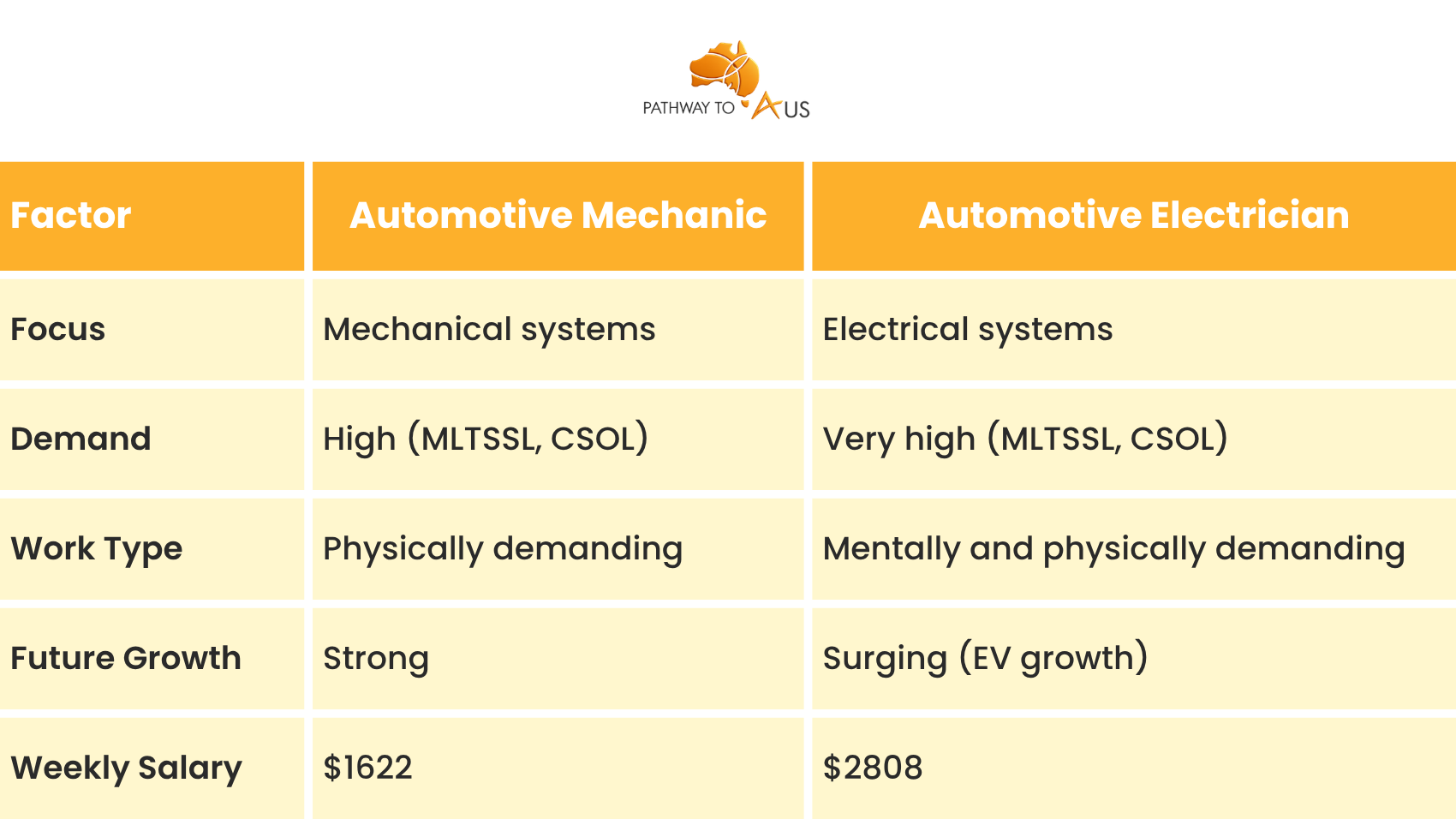
According to Jobs and Skills Australia, an automotive mechanic earns around $1,622 per week (approx. $93,317 annually). In comparison, an automotive electrician earns around $2,808 per week (approx. $161,550 annually).
Both trades offer strong earning potential, but automotive electricians typically earn more due to their specialised skills and increasing demand in modern vehicle technology.
Which Trade Is More In Demand in Australia?
There is consistent demand for both automotive mechanics and automotive electricians in Australia. Both occupations are listed on the MLTSSL and CSOL, meaning they are in demand nationally.
However, automotive electricians currently have stronger demand, driven by the rapid growth of electric vehicles and increasingly complex vehicle electronics. This has created a skills shortage, particularly in diagnostics and electrical systems.
Which Trade Is Better for PR in Australia?
Both automotive mechanic and automotive electrician occupations offer viable PR pathways, as they are listed on key skilled occupation lists.
However, automotive electricians have a stronger long-term PR advantage due to future demand and industry growth. While automotive mechanics still have good PR opportunities, the pathway can be more competitive.
To better understand your eligibility and options, explore our General Skilled Migration page or browse all available visas to Australia.
Automotive Mechanic vs Automotive Electrician: Which Should You Choose?
If you enjoy hands-on mechanical work, prefer engines, and want a stable trade, becoming an automotive mechanic may suit you.
If you’re interested in technology, want a future-proof career, and are aiming for stronger PR opportunities, becoming an automotive electrician may be the better option.
Alternative Pathways to PR Through Trades
Aside from direct skilled migration, other pathways include employer sponsorship or studying a trade, gaining experience, and progressing toward PR.
You can explore these options further through our trade courses and migration pathway resources.
How Pathway to Aus Can Help
Pathway to Aus can help you choose the right trade, align your study with your PR goals, connect you with registered migration agents, and build a long-term pathway in Australia.
Still unsure which pathway is best for you? Book a consultation with Pathway to Aus to explore your options.
FAQ
Is an automotive electrician a good career in Australia?
Yes, becoming an automotive electrician can be a very good career choice in Australia, especially with the rapid growth of electric and hybrid vehicles. The trade offers strong job demand, competitive salaries, and long-term career stability because modern vehicles rely heavily on advanced electrical systems and diagnostics. It can also create strong opportunities for employer sponsorship and PR pathways for skilled workers.
Can automotive mechanics get PR in Australia?
Yes, automotive mechanics can potentially qualify for permanent residency (PR) in Australia because the occupation appears on Australia’s skilled occupation lists such as the MLTSSL and CSOL. However, eligibility depends on factors like age, English level, work experience, qualifications, and migration points. While there are good PR opportunities for automotive mechanics, competition can sometimes be higher compared to more specialised trades.
What qualifications do you need to become an automotive electrician in Australia?
To become an automotive electrician in Australia, students usually complete a Certificate III in Automotive Electrical Technology. This vocational course combines classroom learning with practical hands-on training to prepare students for real industry work. Some students may also gain additional experience through apprenticeships or workplace training after completing their studies.
Which trade earns more in Australia: automotive mechanic or automotive electrician?
Automotive electricians generally earn higher salaries compared to automotive mechanics because they specialise in complex electrical systems and vehicle diagnostics. The increasing demand for electric vehicles and advanced automotive technology has made their skills highly valuable in the industry. However, both trades can still provide strong earning potential and stable career opportunities in Australia.
Are automotive electricians in demand in Australia?
Yes, automotive electricians are currently in very high demand across Australia due to the growing reliance on vehicle electronics and electric vehicle technology. Many employers are looking for workers with diagnostic and electrical repair skills because there is a shortage of qualified professionals in the industry. This strong demand can improve both job opportunities and migration prospects.
How long does it take to become an automotive mechanic in Australia?
It usually takes around 12–24 months to complete the required vocational training to become an automotive mechanic in Australia, depending on the course and study pathway. Many students complete a Certificate III in Light Vehicle Mechanical Technology, which includes both theory and practical training. Some people may also continue with apprenticeships or further study to specialise in diagnostics or advanced repairs.
Can international students study automotive courses in Australia?
Yes, international students can study automotive mechanic and automotive electrician courses in Australia on a student visa. These courses are popular because they provide practical skills, industry experience, and potential pathways toward employment and migration opportunities in Australia. Students also benefit from hands-on learning and exposure to modern automotive technologies.
What is the difference between an automotive mechanic and an automotive electrician?
Automotive mechanics mainly work on mechanical parts of vehicles such as engines, transmissions, brakes, and suspension systems. Automotive electricians focus on electrical systems including wiring, batteries, lighting, diagnostics, and vehicle electronics. While both trades involve vehicle repairs and maintenance, automotive electricians generally work more with technology and electronic systems.
Do automotive trades lead to PR in Australia?
Potentially, yes. Many automotive occupations are listed on Australia’s skilled occupation lists, which may create pathways through General Skilled Migration or employer-sponsored visas. However, PR eligibility depends on several factors including occupation demand, work experience, skills assessments, English proficiency, and points score at the time of application.
Which automotive trade is better for the future?
Both automotive mechanics and automotive electricians have strong future demand in Australia, but automotive electricians currently have an advantage because of the growing electric vehicle market and increasing vehicle technology. As cars become more advanced and reliant on electronic systems, specialised electrical and diagnostic skills are becoming even more valuable. However, automotive mechanics will still continue to play an important role in the industry for many years.