


If you're planning to study in Australia as an offshore trade student, the first number that tends to catch people off guard isn't the total cost. It's the assumption that all of it needs to be paid at once. The good news is that it doesn't work that way, and once you understand how the upfront costs are actually structured, the move starts to feel a lot more achievable.
Every week, we work with offshore students who are moving over to study trades like carpentry, painting and bricklaying. The costs are consistent, the timing is staggered, and the whole thing becomes far more manageable when you can see the sequence clearly.
Here's what to plan for, in the order you'll actually spend it.
Key Takeaways:
- Because the upfront expenditures are spread over several months rather than paid in one single sum, moving abroad to study in Australia is significantly less expensive than the overall price indicates.
- The college enrolment deposit, OSHC, the Subclass 500 visa fee, one-way airfare, and short-term lodging are the five primary upfront expenses for an offshore trade student.
- On July 1, 2026, the Subclass 500 base visa price was changed to AUD $2,500. Therefore, before you apply, always check the current amount on the Department of Home Affairs website.
- Once you are on the ground, you will find more affordable and suitable shared accommodations, so it makes more sense to book a hostel for your first one to three weeks rather than signing a long-term lease from offshore.
- Startup costs sit around AUD $9,000 in total for a single applicant, but the cost of living in Australia as a student continues after arrival and varies noticeably between cities.
5 Upfront Costs You Need to Plan For
Before we go into the detail, here's the shape of your startup budget. These are indicative figures for a single offshore applicant enrolling into an average two-year trade pathway.
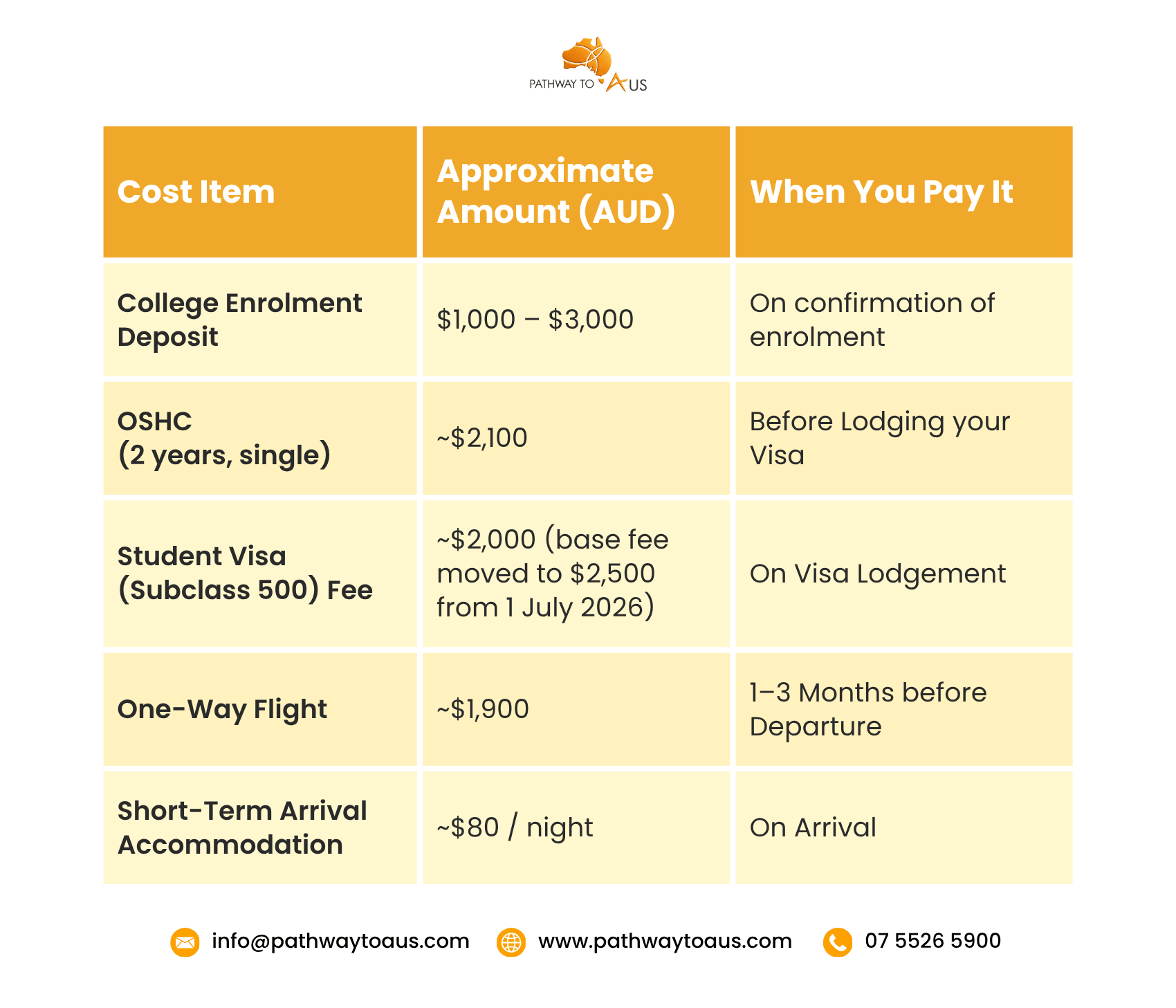
Take note of the one lump payment that is absent from that list. The entire thing feels heavier when it's put together on paper than when you're actually going through it because each line has its own place in the narrative.
1. College Enrolment Deposit
Your college enrolment deposit, which usually ranges from $1,000 to $3,000 AUD, is the first payment you'll make. It covers your enrolment fee, part of your material fees, and a portion of your first tuition instalment.
In other words, it isn't a separate charge you'll never see again; it's a portion of your overall course cost brought forward.
A useful thing to know is that once this deposit is paid, you don't need to touch the rest of the budget for a while. Your course start date might be two months away, six months away, or in some cases close to a year, and everything else in the sequence waits until you're much closer to lodging your visa.
That breathing room is what allows most students to fund the move out of ongoing savings rather than needing a huge sum ready at the start.
If you're still deciding which trade or provider suits your goals, our team can help match you to the right program through Find a Course so the deposit you place is one you're confident in.
2. Overseas Student Health Cover (OSHC)
The next line item is Overseas Student Health Cover, which comes in at around AUD $1,000–$2,500 for a single applicant over 2 years, depending on the provider and level of cover.
OSHC covers emergency care, hospital treatment and most standard medical costs across the full duration of your student visa, and it's a mandatory piece of the puzzle rather than an optional extra.
The reason OSHC gets paid upfront, rather than as a monthly subscription, is that the Department of Home Affairs needs to see it in place before your Subclass 500 visa can be lodged. Trying to work around this or delay it doesn't save money; it just delays the whole application. Building it into your visa-lodgement window keeps everything flowing in the right order.
3. Australian Student Visa (Subclass 500)
Most people prioritise the Australian student visa, which makes sense. As of this 1 July 2026, AUD $2,500 is the new base application fee. When you lodge, always check the current amount on Home Affairs' website as they update these visa charges on a regular basis.
More than most people know, timing is crucial in this situation. As an offshore applicant, you can generally lodge your Subclass 500 visa around 120 days before your course start date. Once it's granted, you can enter Australia any time before your course begins, which gives you a comfortable window to book flights, sort accommodation and arrive with time to settle in rather than rushing straight into orientation.
Educate to Migrate Service
Studying and migrating are two halves of the same plan, and getting them working together is where most offshore students save time and money. This service explains how choosing a course, scheduling a visa, and post-study alternatives all fit into a unified plan. Speak with one of our consultants now for a more thorough explanation of the connections between enrolment, visa, and post-study pathways.
4. Booking One-Way Flights
Using London to Sydney as an example, your flights cost about $1,900 AUD for a one-way ticket. It's the one line item where a little preparation actually saves money because that amount varies depending on the season and how far in advance you book.
A one-way ticket is deliberate. You're relocating, not visiting, and paying for a return leg you won't use tightens your budget for no reason.
If you're booking a few months in advance, keep an eye on the seasonal spikes (he December to January window and the June to July window both push prices up). You can also consider stopover carriers, which often come in noticeably cheaper than direct flights.
The rule of thumb is simple: last-minute one-way flights to Australia get expensive quickly, and every month you plan ahead widens your options.
5. Short-Term Arrival Accommodation
The final upfront cost is the one most first-time students get wrong. Instead of committing to a long-term property before you arrive, plan to stay somewhere flexible for the first one to three weeks and budget about $80 per night for a hostel or short-term stay.
The reason is practical. Australian landlords generally want a local rental history, references and bond, none of which you'll have on day one. Locking yourself into a suburb before you've met your classmates, seen the city or worked out your commute usually leads to a second, more expensive move a few months in.
Public transport across Australian cities is genuinely good, so you don't need to live on the school's doorstep to keep your commute short.
The smart play is to book a hostel for the first stretch, meet other students who are already looking for housemates, and move into shared accommodation once you actually know where you want to be.
It's cheaper, more sociable, and puts you in far better long-term rentals than anything you could have arranged from offshore.
Australia Arrival Guide: Accommodation
The first two weeks in Australia might determine whether a transfer is easy or costly. How to avoid signing a long-term lease before you're ready, share-house culture, and hostel recommendations are all covered in our Australia Arrival Guide.
Why These Costs Are Staggered — and Why That Matters
Add the five figures together and the total sits around $9,000 AUD before you've eaten your first meal in Australia. On paper, that looks daunting. In practice, it never lands in one hit.
Your deposit is paid the moment you commit to a course, often six or more months ahead of departure. Your OSHC and visa follow together about 120 days before your course starts. Flights get booked in the month or two before you fly, and your first weeks of accommodation are paid on arrival. The consequence is that most students fund the move from ongoing income and savings rather than needing the full amount available on day one.
Startup Costs vs Ongoing Costs
It's worth flagging what this article doesn't cover.
Once you land, you'll also need to budget for weekly rent, groceries, transport, ongoing tuition instalments, and any tools or materials that weren't included in your deposit.
The cost of living in Australia as a student varies noticeably between cities, and it's the piece of the budget that runs continuously rather than sitting at the start of the journey.
Our advisers can walk you through actual weekly estimates for the city and course you're pursuing if you want an idea of what to expect once you're on the ground.
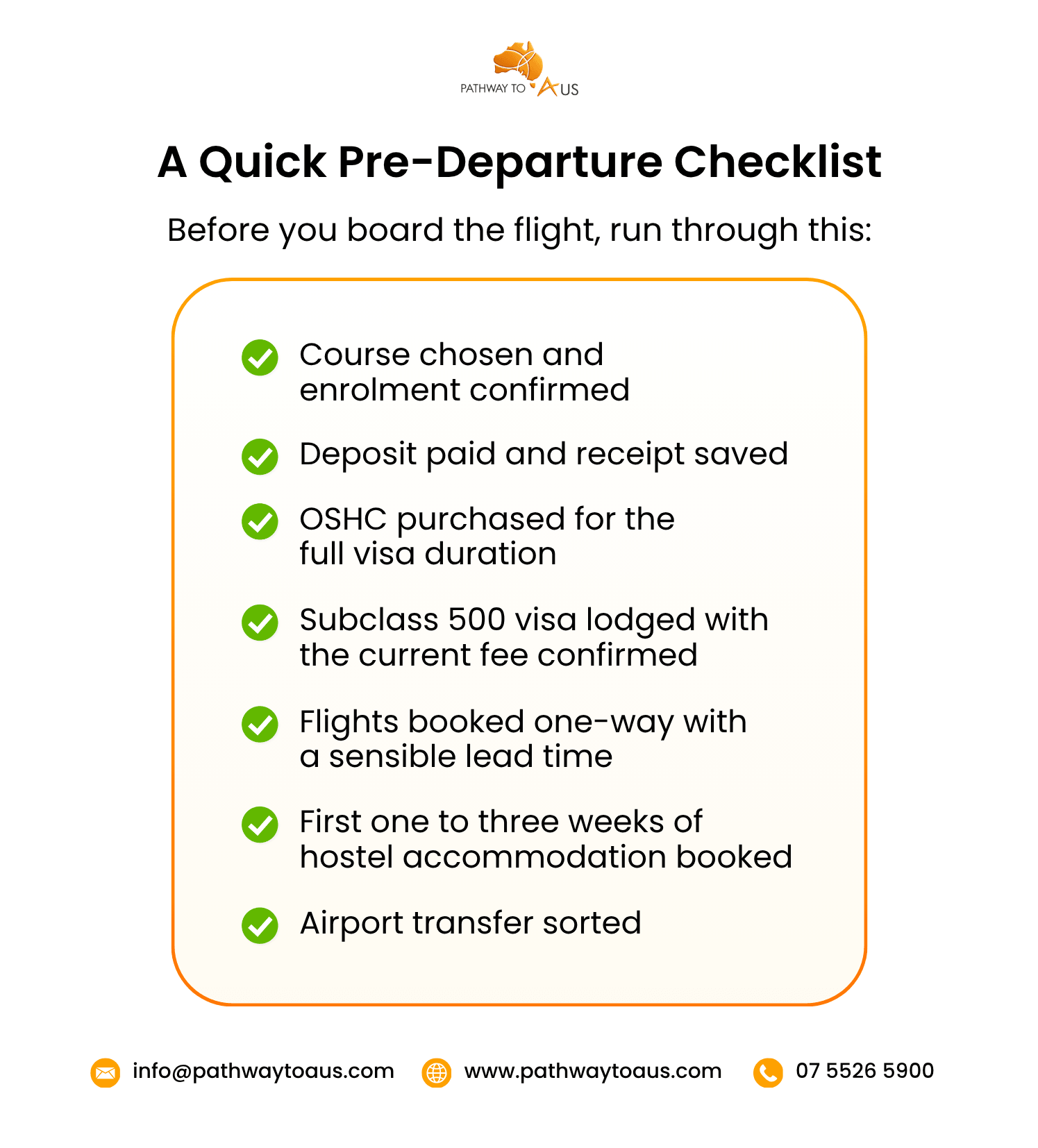
It's better to stop and double-check if any of those things seem hurried. Time and money are lost later due to small mistakes made early.
Get the Right Advice Before You Commit
Moving offshore to study in Australia is a much more achievable step than the total figure suggests, provided the sequence is set up properly and the course you enrol into aligns with where you want to end up. The upfront costs are consistent, the timing works in your favour, and with a clear plan the whole thing becomes a matter of stages rather than one big leap.
If you're thinking about a trade pathway and want to see how the numbers, timing and enrolment fit together for your situation, book a consultation with the team at Pathway to Aus and we'll help you map it out from your first deposit through to your arrival week.
Frequently Asked Questions
How many hours can international students work while studying in Australia?
During term time, international students with a Subclass 500 visa are permitted to work up to 48 hours every two weeks, and during planned course breaks, they are permitted to work an unlimited number of hours. The two-weekly cap does not apply to postgraduate research students (PhD and Master's by research).
What IELTS score do you need to study in Australia?
After being raised from the previous 5.5 level in 2024, the minimum IELTS score for an Australian student visa is now 6.0 overall. ELICOS or foundation/pathway packages have lower criteria, whereas specific courses and universities may have greater prerequisites.
How much bank balance do you need for an Australian student visa?
Offshore Student visa applicants generally need to show AUD $29,710 in funds for the primary applicant to cover 12 months of living expenses, plus additional amounts for a partner (AUD $10,394) and each dependent child (AUD $4,449), on top of tuition and travel costs.
Can I stay in Australia after graduation on a student visa?
Your student visa is valid for the length of your study plus a brief extension, usually one to two months, or until March 15 of the following year if your course ends in November or December.
If you want to stay longer, you can apply for a Temporary Graduate visa (Subclass 485), which, depending on your qualifications, permits qualified graduates to stay in Australia for up to 18 months (Post-Vocational Education Work stream) or often 2 to 3 years (Post-Higher Education Work stream).
Can you bring your family with you on a student visa to Australia?
Yes. For Student visa purposes, a family member is your partner or a dependent child (yours or your partner's) who is unmarried and has not turned 18. Family members should ideally be listed on the original application, and you must also show additional financial capacity for each of them and meet health and character requirements.